Loading
0
Vault Collective

Index
Index

The Ultimate Trading Guide
A consice guide that covers my personal research on the fundamentals of trading
By Theo Bokman
Index
Introduction
Disclaimer
Not financial advice.
The information, strategies, and insights shared within this textbook are provided for educational and informational purposes only. This material is NOT intended to serve as financial advice or guidance for trading or investing and should not be interpreted as such. You are fully responsible for any decisions you make based on the content within this text.
Vault Collective by Essencial or any of its parties thereof, do not guarantee profits or success and shall not be liable for any losses, damages, or liabilities that may arise from the application of the strategies or information in this textbook. Trading and investing in cryptocurrencies involve significant risks, including but not limited to market volatility, loss of principal, and potential financial instability.
By using the information presented in this textbook, you agree to take full responsibility for your own financial decisions. Always conduct your own research, consult with licensed financial professionals, and carefully consider your risk tolerance before making any investment or trading decisions. The methods shared in this book are personal strategies and may not be suitable or appropriate for all individuals or market conditions.
No warranties or guarantees are provided regarding the accuracy, completeness, or reliability of any information in this textbook. All content is presented “as-is,” and it is crucial to be aware that the cryptocurrency market is constantly changing and unpredictable.
By proceeding with the materials in this textbook, you acknowledge and accept these terms and conditions. The author assume no responsibility for any financial outcomes or losses that may result from following the information provided.
Introduction
About me
My name is Theo Bokman, and I’ve been in the crypto game for over half a year, building countless portfolios from scratch. With close to a million dollars in trading volume, I’ve learned what it takes to succeed in this space and have developed a proven system.
Follow my journey: @theobkmn on Instagram · youtube.com/@theobokman on YouTube:
You might be wondering why I chose crypto — I still wonder the same even at the time of writing this. To put it plainly, I wanted to put my time into something productive. It started with dropshipping in January, where I got my first winning store but found it a very slow rinse-and-repeat process.
Fast forward to April: I opted for crypto because of the fast-paced environment paired with instant returns. I ended up making my first $1,000 within a week, and it felt like I was on top of the world. And I guess the rest is history.
To be completely transparent — my crypto journey was far from linear. Not only have I been dead broke with less than a dollar to my name, I’ve also been in desperate situations where my only option was to take responsibility for my own actions and move forward.
This guide should not only serve as a testimonial for my success but also allow you to see that this is something you can achieve for yourself. The way I see it — if I could do it, you are more than capable of doing it too.

Introduction
The Goal
"Oh you're 20 and want to have fun with your friends? You will never have such easy opportunities for generational wealth even if you live another 80 years."
If capital is something that you struggle with — maybe you’re young or haven’t landed that entry-level job yet — I would highly suggest self-learning using this guide combined with YouTube to familiarise yourself with the world of Futures and Crypto as a whole. Set aside a portion of capital for “learning fees” (trading losses) that you don’t mind losing initially, while you progress and build your income base.
If capital is not an issue, you may skip through this section entirely. The rationale behind this guide is so that your starting capital will be put towards meaningful progress over meaningless losses. I made a lot of mistakes starting out. So I seriously dedicate this guide to that clueless self of mine when I first started — and now it will serve you.
The main goal for this guide is to make the entry-level requirements to trade Crypto Futures as low and as easy as possible for newcomers and seasoned traders alike. To enable you to test new waters and ultimately determine if this is something you can pursue as a hobby, side-hustle, or even a lifelong career.
What sets this guide apart is that I take pride in having educated over 1,000+ individuals over the last year. My personal connections with mentorship students now allow me to transform thousands of explanations onto paper — giving you the best chance at success.
My greatest hope is that this guide propels you to become an even better trader than me, in half the time. I can say with confidence — this guide would have saved me months of trial and error.
Proof of Results
Introduction
Annex One - Glossary
Before diving in, familiarise yourself with these core terms. They appear throughout every module.
Cryptocurrency : a digital or virtual currency secured by cryptography, operating on a decentralised network with no single controlling authority
Blockchain : a permanent, public, decentralised ledger recording every transaction across a network of computers — impossible to alter after recording
Decentralisation : distribution of control away from a central authority; no CEO, government, or bank is in charge
Token : a digital asset on a blockchain representing value, utility, or rights; each token has a unique contract address
Contract Address (CA) : a unique identifier permanently tied to one specific token — like a passport number for that coin
Memecoin : a cryptocurrency inspired by a meme or internet trend; community-driven and highly volatile (e.g. DOGE, PEPE, WIF)
Pump and Dump : insiders artificially inflate a token’s price, then sell their holdings, crashing the price and leaving retail investors at a loss
Volatility : how much and how quickly an asset’s price moves; high volatility means large swings in short periods
Layer-1 Blockchain : a base-level blockchain (e.g. Solana, Ethereum, Bitcoin) that independently processes transactions and supports smart contracts
Altcoins : any cryptocurrency that is not Bitcoin; most are tokens built on top of Layer-1 blockchains
Liquidity Pool : tokens locked in a smart contract to provide liquidity for decentralised exchanges, enabling trading without a traditional order book
Futures Contract : an agreement to buy/sell an asset at a predetermined price at a future date; in crypto, perpetual futures have no expiry and use leverage
Leverage : borrowing capital to amplify trade size; 10× leverage on $100 = $1,000 exposure, multiplying both gains and losses
Long : a futures position that profits when price rises; betting price goes up
Short : a futures position that profits when price falls; betting price goes down
Liquidation : the exchange forcefully closes your position when your margin falls below the required level; you lose your margin
Take Profit (TP) : pre-set price to close and lock in gains
Stop Loss (SL) : pre-set price to close and cap losses
Break Even (BE) : SL moved to entry; worst outcome is $0 P&L;
Funding Rate : periodic payment between longs and shorts in perpetual futures; keeps futures price anchored to spot price
USDC : USD Coin — a stablecoin pegged 1:1 to the US dollar, used to hold value between trades
Open Interest (OI) : total value of all outstanding futures contracts on an exchange; rising OI with rising price suggests a strong trend
Slippage : difference between expected and actual execution price; higher in low-liquidity conditions
PnL : profit and loss — realised (position closed) or unrealised (position still open)
Perpetual Futures (Perp) : a futures contract with no expiry date; the most common type in crypto
Introduction
Trading Terms
Market Hours
Crypto markets trade 24/7 : no close unlike the stock market
US Stock market : 9:30 AM – 4:00 PM EST (Mon–Fri)
Extended hours : Pre-market 4:00 AM EST, After-hours until 8:00 PM EST
Best crypto trading windows : London Open (3pm SGT) and NY Open (9:30pm SGT)
Basic Terms
Buy / Long : opening a position expecting price to rise
Sell / Short : opening a position expecting price to fall
Ask : the price sellers want for their asset
Bid : the price buyers are willing to pay
Ask-Bid Spread : the difference between ask and bid
Bull / Bullish : expecting or positioned for price to rise
Bear / Bearish : expecting or positioned for price to fall
Take Profit (TP) : pre-set price to close and lock in gains
Stop Loss (SL) : pre-set price to close and cap losses
Break Even (BE) : SL moved to entry; worst outcome is $0 P&L;
Volume : number of contracts/coins traded in a period
Scalp : short-term trade (minutes to hours)
Short Swing : position held through the day or overnight
Long Swing : position held for weeks or months
Advanced Terms
Limit Buy : buys only at your specified price or better; no slippage
Market Order : executes immediately at current price; may have slippage
VWAP : Volume-Weighted Average Price; key institutional reference level
EMA : Exponential Moving Average; dynamic support/resistance indicator
Leverage : borrowing capital to amplify position size
Liquidation : exchange force-closes position when margin runs out
Funding Rate : periodic payment between longs and shorts in perp futures
Open Interest : total value of all outstanding futures contracts
Averaging Down : buying more as price falls (risky with leverage)
Volatility : how fast price moves up or down
BTO / STC : Buy to Open / Sell to Close
PnL : Profit and Loss (realised or unrealised)
Module // 01
Why Crypto?
1.1 // Why Crypto
What is Cryptocurrency?
1.2 // Why Crypto
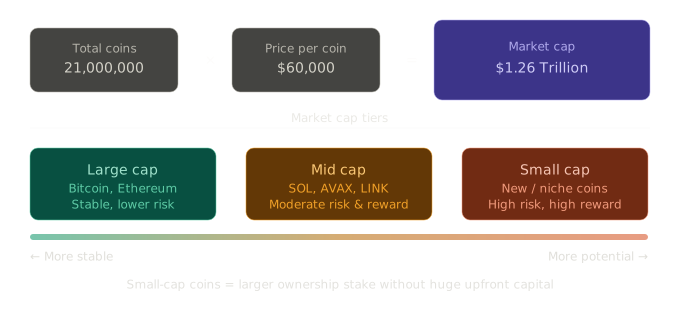
Market Cap Explained
Higher market cap = larger, more stable asset (Bitcoin, Ethereum)
Lower market cap = riskier, but higher potential returns
Small-cap coins allow a larger ownership stake without huge upfront capital
1.3 // Why Crypto
Blockchain Basics
Blockchain is the backbone of all cryptocurrencies. Think of it like fingerprints: every transaction is unique and impossible to tamper with. This public transparency builds trust without a central authority like a bank.
Bitcoin is permanently limited to 21 million coins — nobody can print more. This fixed supply is why many see Bitcoin as a hedge against inflation.
Module // 02
App Setup
2.1 // App Setup
The Setup
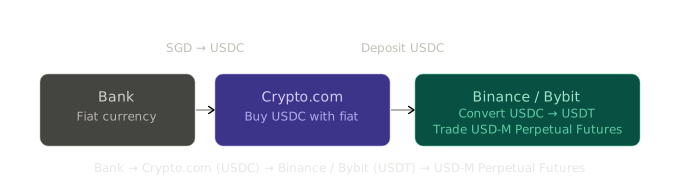
Before you can trade Crypto Futures you need two things: a custodial exchange to buy crypto with your bank, and a trading platform to execute futures trades. Phantom Wallet is the bridge between them.
2.2 // App Setup
Custodial Wallets
Crypto.com - Primary (Recommended)
You need to be 18+ (or have a parent sign up). Crypto.com creates a custodial wallet — they manage your private keys, providing better security and ease of use. This is where you convert fiat (SGD/USD) to USDC at zero fees, then transfer to Phantom. Also used to store long-term profits.
Crypto.com
Use my referral code: rkz4cgjrsy
Website: crypto.com/sg
Available on Google Play & Apple App Store
Referral code (free fee discount): rkz4cgjrsy
Use for: buying USDC, long-term profit storage, staking
Coinbase - Backup Option
Same features and purpose as Crypto.com. Use if Crypto.com is unavailable in your region. Note: fees can be higher for some transactions. Website: coinbase.com

Coinbase
Backup option
2.3 // App Setup
Trading Platforms - Futures
Binance - Primary Futures Platform
Must be 18+ with KYC verification. Binance is the world’s largest crypto exchange. Use the USD■-M Perpetual Futures section. Supports high leverage, deep liquidity, and a full charting suite. This is where you execute all your futures trades.

Binance
Use my referral code: 880414121
Website: binance.com
Products: Futures (USD■-M Perpetual), Spot, Wallet
Start on the Futures Testnet to practise without real capital
Complete KYC identity verification before depositing
Bybit - Alternative Platform
Must be 18+. Strong alternative with clean UI and competitive fees. Use if Binance is unavailable in your region. Website: bybit.com

Bybit
Alternative Futures Trading Platform
2.4 // App Setup
Non-Custodial Wallet - Phantom
Cheaper than buying a physical Cold Wallet (I use Trezor now), Phantom is your go-to Non-Custodial wallet while starting out, it has self-hosted swapping partners like Jupiter that can help you diversify your profits and start physically owning BTC, ETH, and even SOL. Great starting point to flexing some of those profits and portfolios over tanking the terrible exchange rates and fees on main exchanges like Crypto.com, Coinbase and Binance. Think more privacy and less fees.
Phantom is non-custodial — YOU manage your own private keys. It primarily supports the Solana blockchain, includes an in-app browser for DeFi, and is also available as a Chrome extension on desktop.
IMPORTANT: If you are UNDER 18 (but 16+), you can purchase USDC for a slightly higher fee using any Visa or Mastercard using Phantom’s built-in store. Note: Some providers require KYC, you’ll have to find the one that doesn’t or just get someone to do it for you and then bank transfer them (Or PayNow if you live in Singapore).
Phantom
Non-custodial Wallet - phantom.com
Website: phantom.app · Chrome extension + mobile (iOS & Android)
Use it daily: to manage your spot swaps and physically own various cryptocurrencies
Lowest conversion fees when buying/selling spot tokens
Supports NFTs, Solana DeFi, and multiple chains
2.5 // App Setup
How to Fund Your Account With Zero Fees (5 Steps)
Follow these five steps to get from cash in your bank account to crypto in your trading platform with zero fees.
Step 1 - Add SGD to Crypto.com
Open your Fiat Wallet in Crypto.com and follow the on-screen instructions to add SGD as your new currency. It will ask you to add one of Crypto.com’s bank accounts as a local recipient so you can deposit cash directly from your bank without fees.
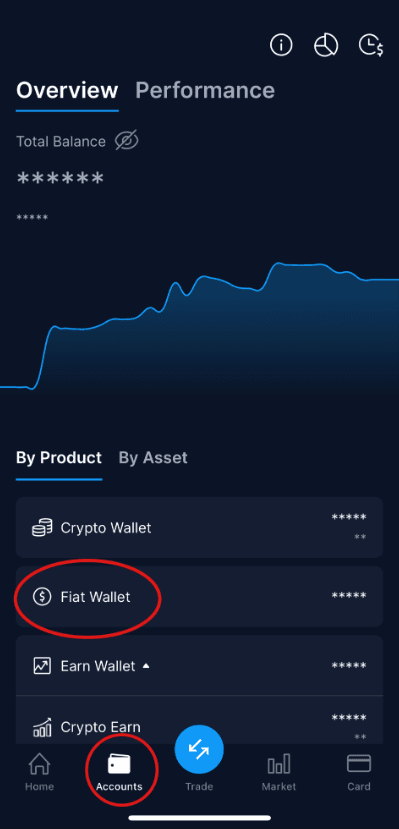
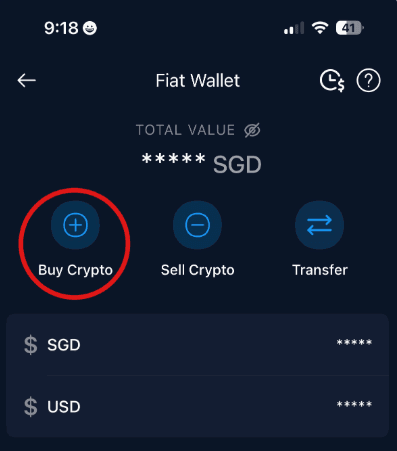
Step 2 - Buy USDC at Zero Fees
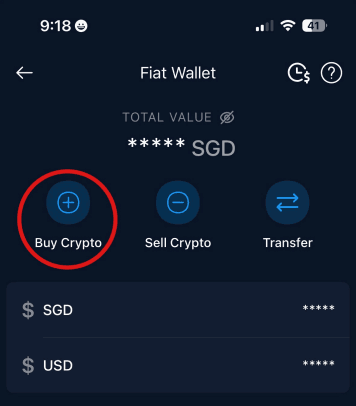
After depositing SGD, tap “Buy Crypto” inside your Fiat Wallet and select USD Coin (USDC). USDC is pegged 1:1 to the US dollar — it is your stable base currency. No fees apply when buying via bank transfer.
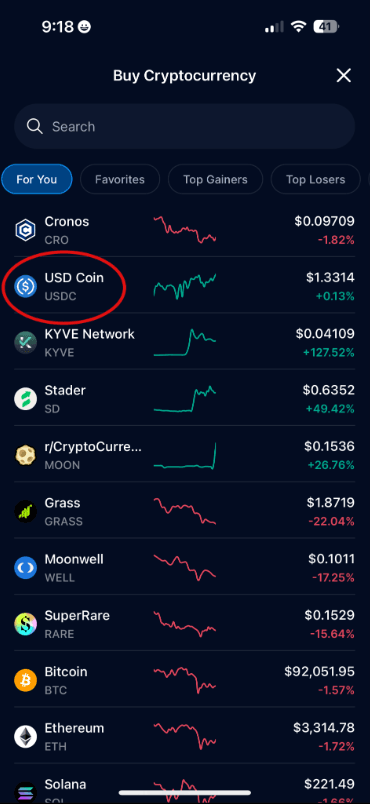
Step 3 - Transfer USDC to your exchange of choice (in this case we will be using Binance)
Buy however much USDC you want to begin trading with. Then in your Crypto Wallet, select USD Coin → Transfer → Withdraw → External Wallet → “+” to whitelist a new wallet. Select the Solana network and paste your Binance Solana network address.
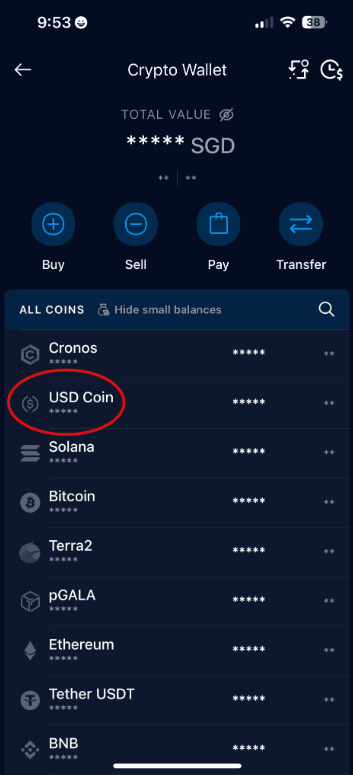
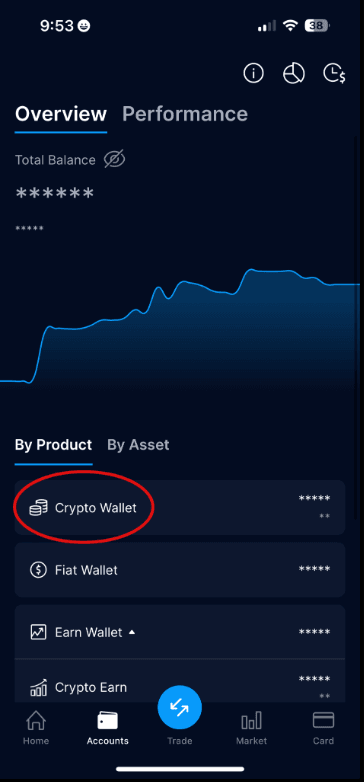
Step 4 - Find Your Binance Solana Network Address
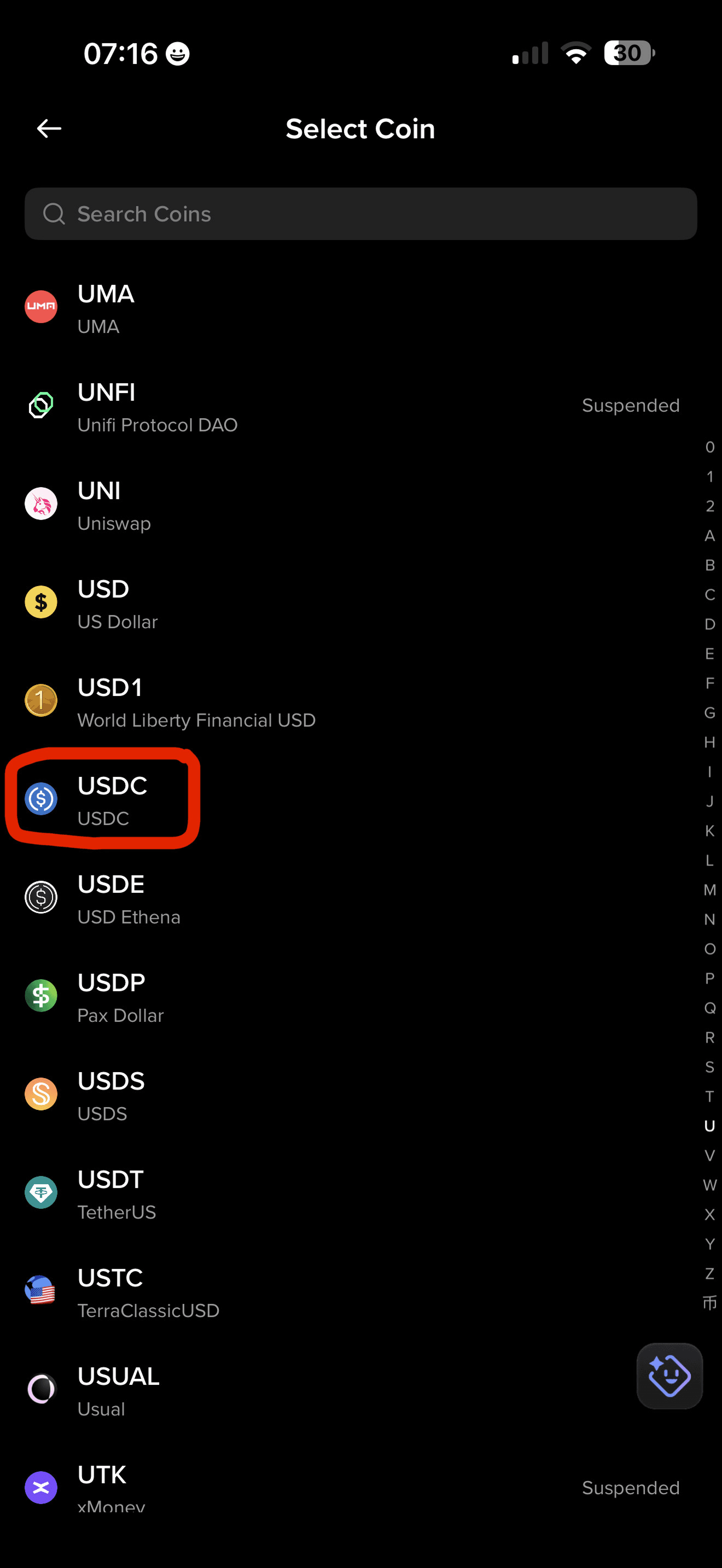
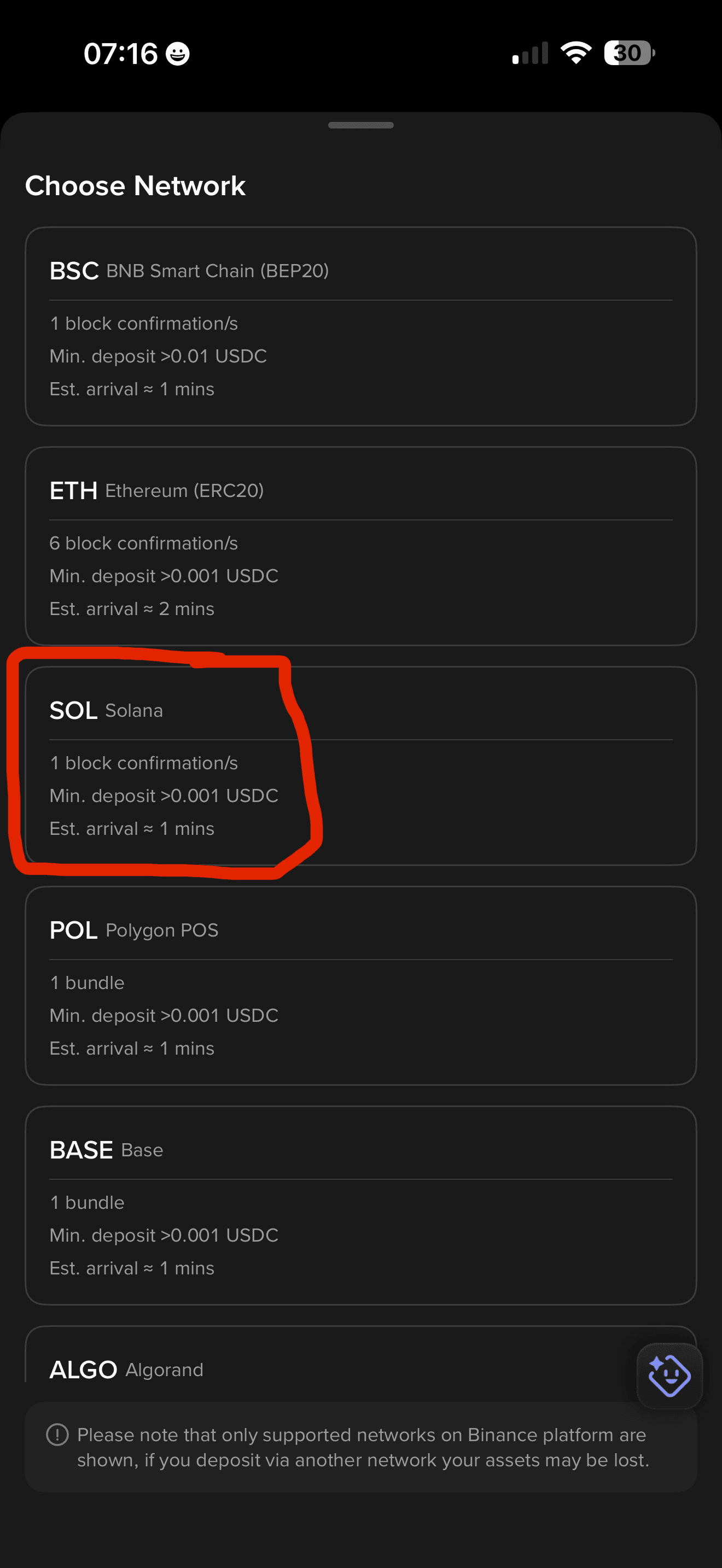
In Binance after creating an account, tap your Assets button, then press “Add Funds”. A pop-up menu will appear where you will see “Deposit Crypto”. Click on that and it will prompt you to select which cryptocurrency you would like to deposit.
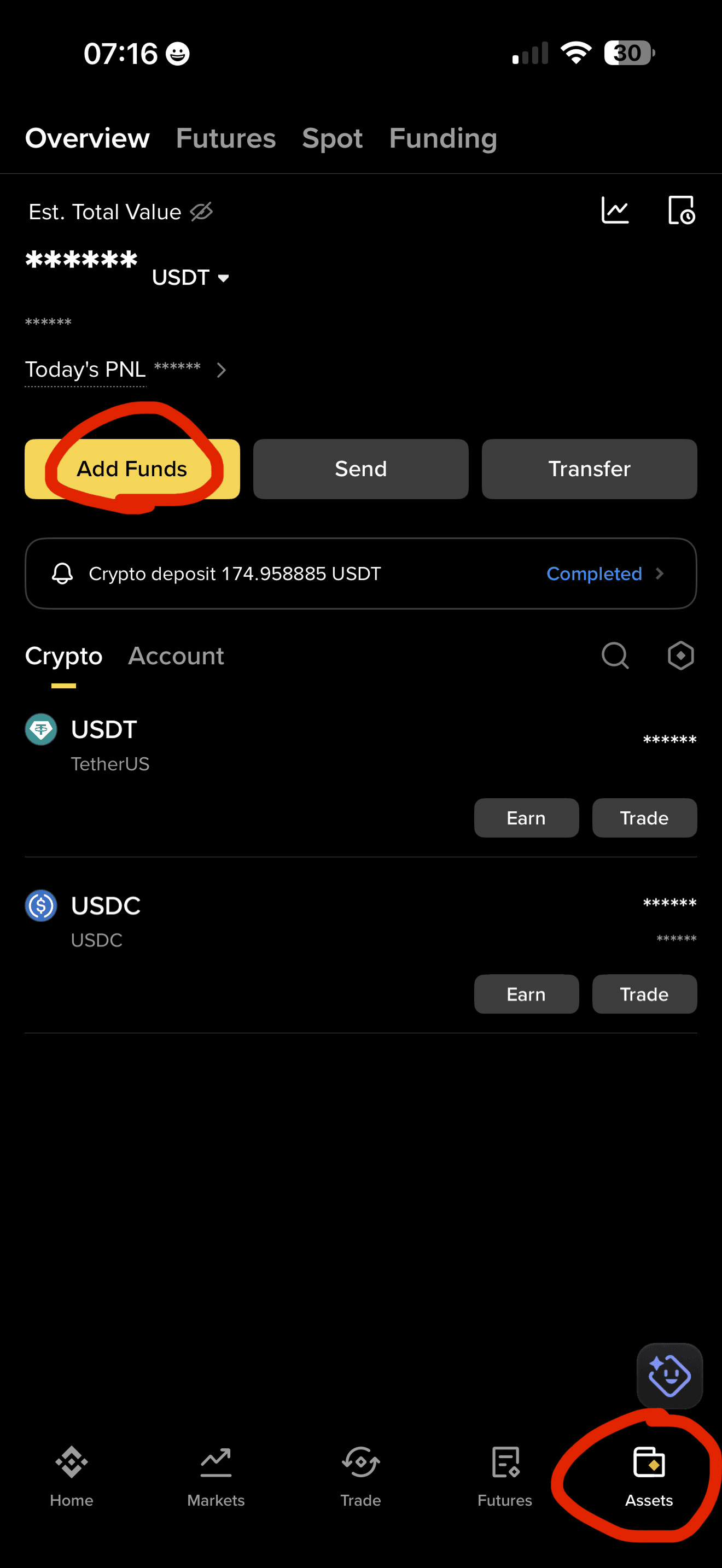
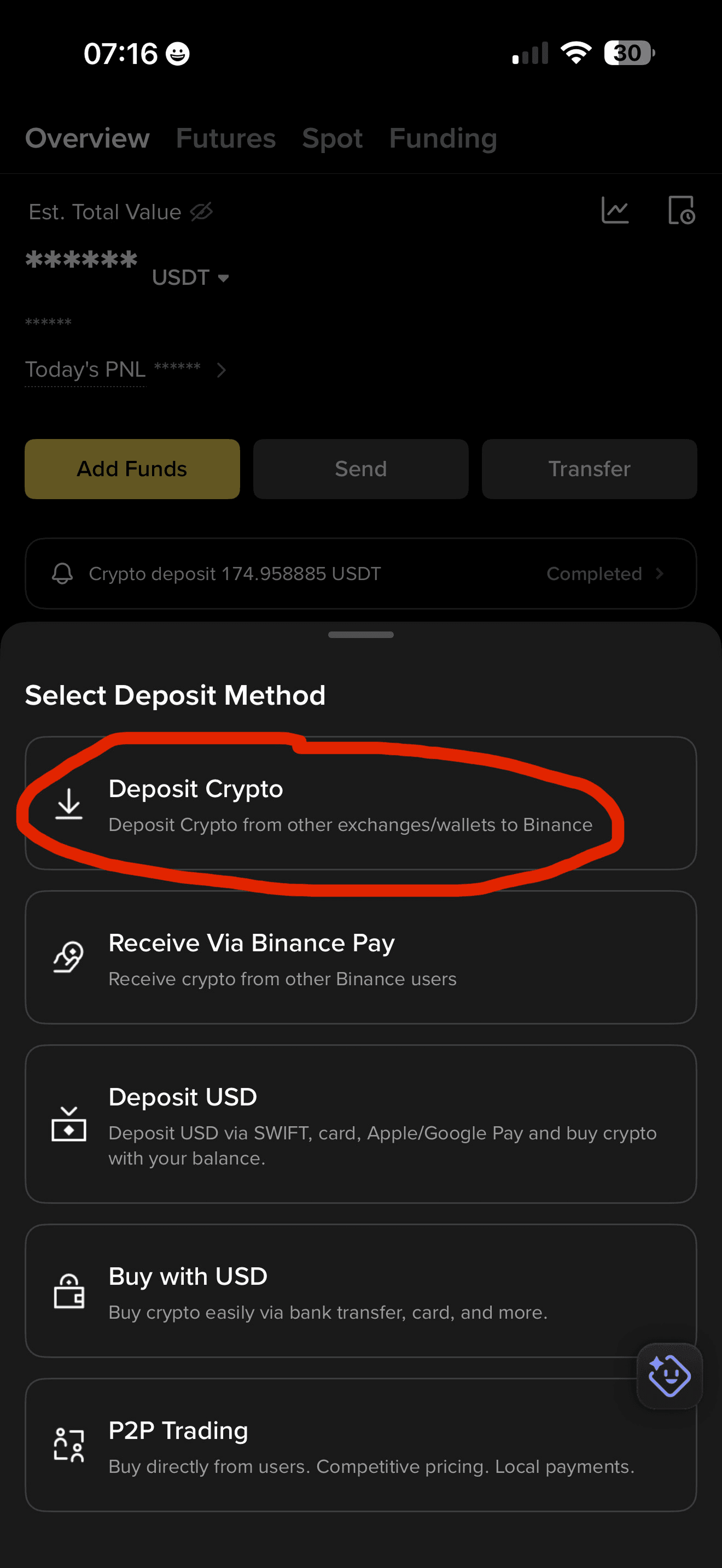
Step 5 - Finish finding your Solana Network Binance Address for USDC transfers
Scroll down or search “USDC” until you find USDC with the Blue “$” icon. Select it, and it should ask you to “Choose a Network” to which you will select “SOL” Solana of course. Once you have made it to this step you will see “Deposit USDC” on the top of the screen followed by a QR code and your “Deposit Address” which should look something like “Bn2q…8srb”. Copy the address, paste this into Crypto.com as your external wallet destination and nickname it “Binance” so you won’t get confused in the future.
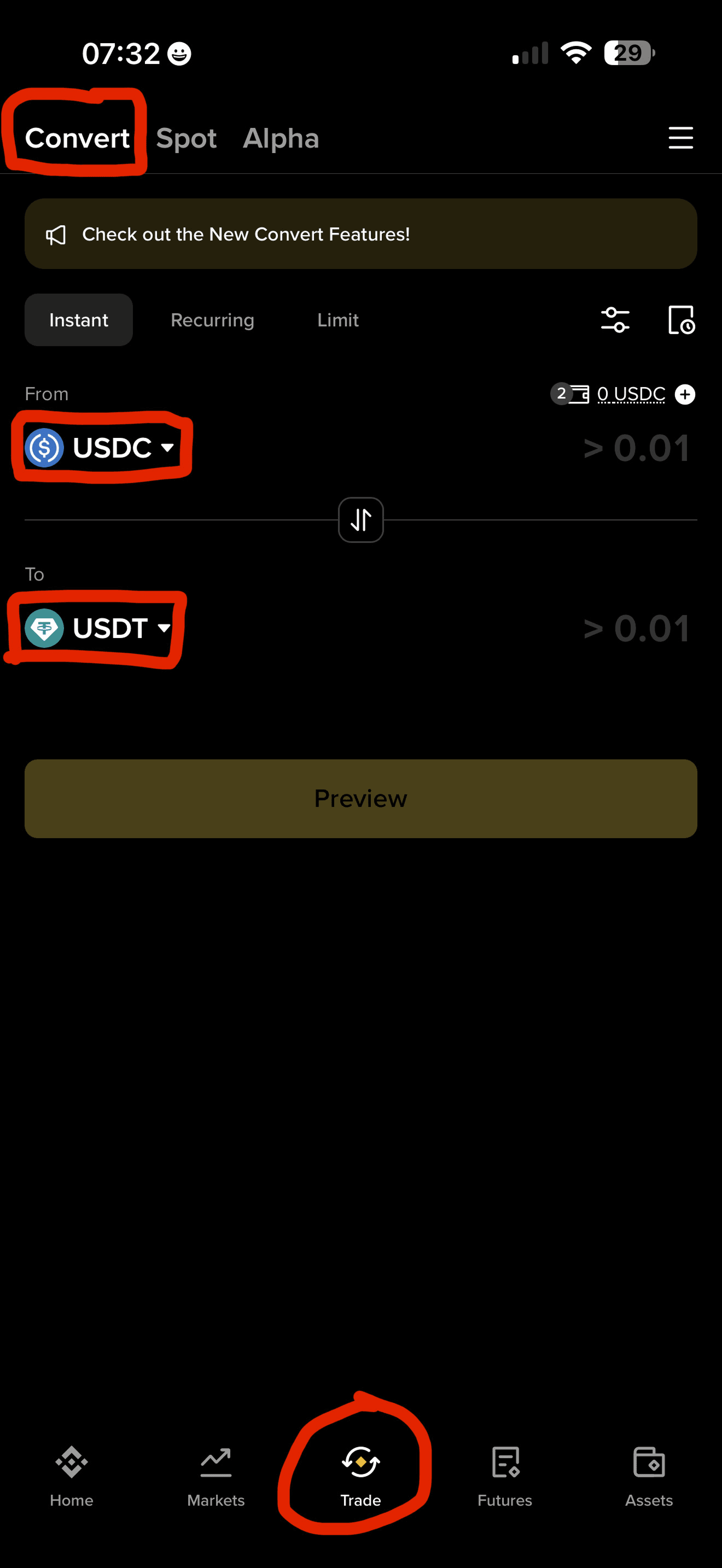
Step 6 - Setup Tips and Converting USDC -> USDT -> USD-M
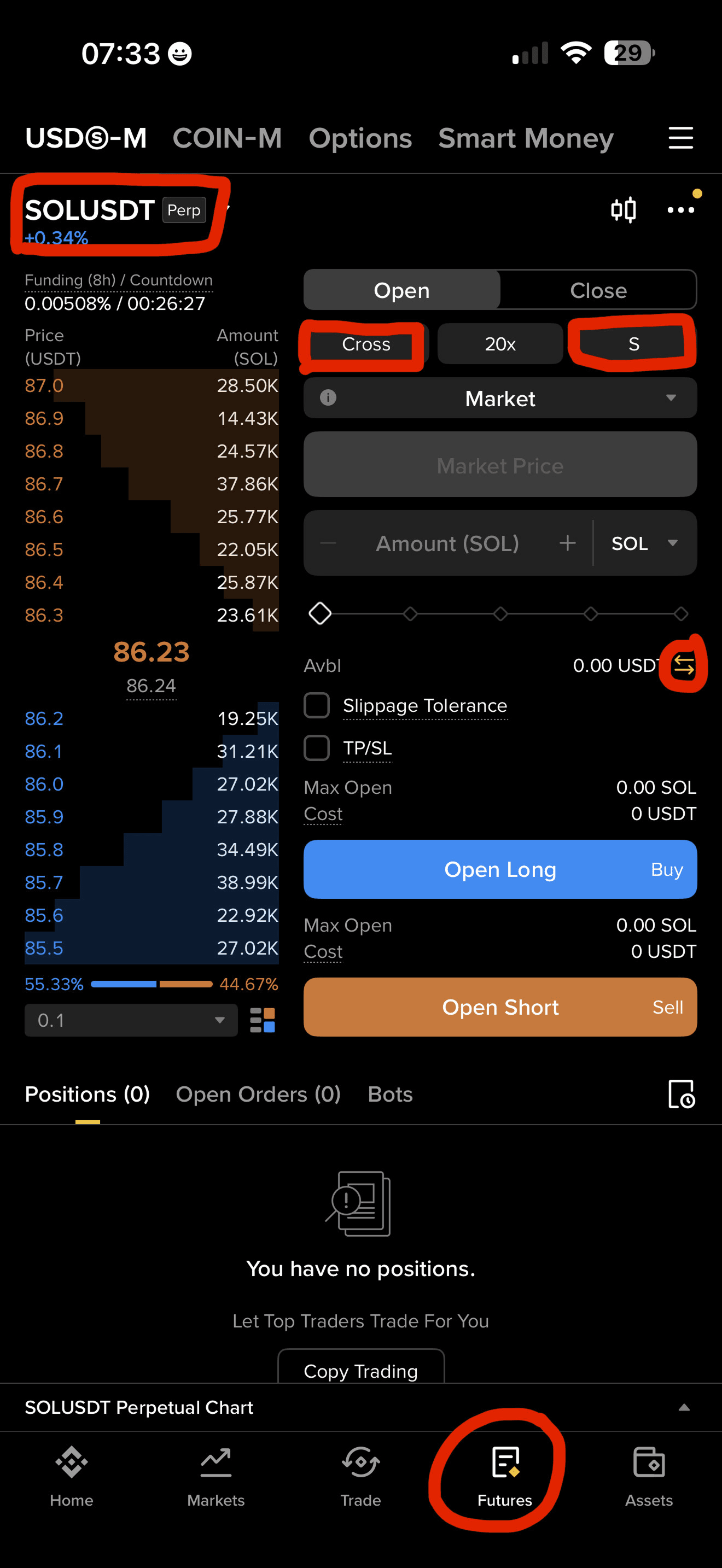
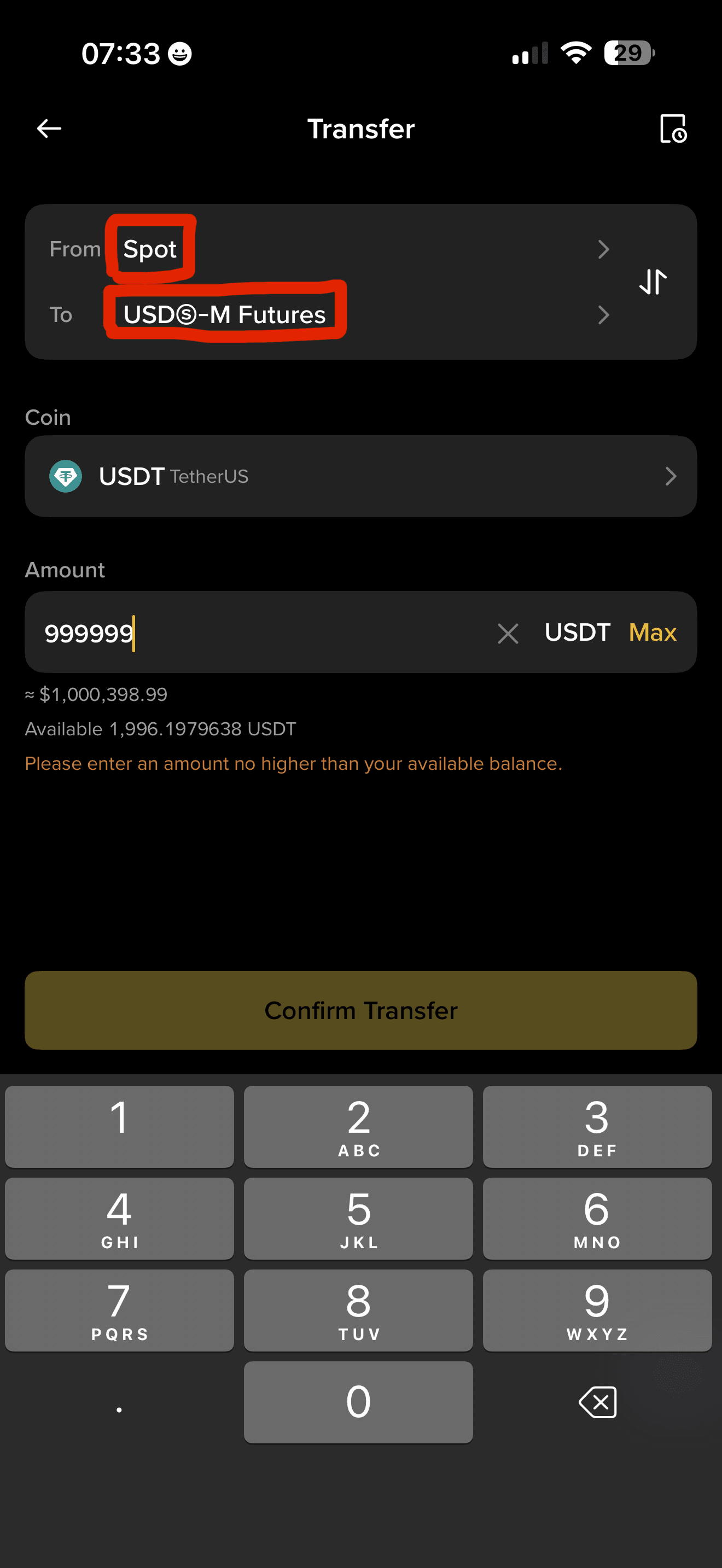
First you want to Convert your USDC to USDT using Binance’s built-in service, just simply follow my red circles in the first screenshot. Once you have converted however much USDC into USDT, navigate to the “Futures” tab and you can start by selecting the coin you would like to trade on the top left, followed by setting your Margin to “Cross” and switching to “Single-Asset Mode”.
Below you will see two arrows which is where you will be converting your Spot USDT into USD-M Futures USDT (Vital Step). Once you have transferred your desired amount you are ready to start trading Binance Futures! And of course to withdraw anything you simply need to follow this process backwards, and your funds can land straight in your bank account (if you live in Singapore) within about 5-10 minutes.
Module // 03
Trading Fundamentals
3.1 // Trading Fundamentals
Candlestick Patterns
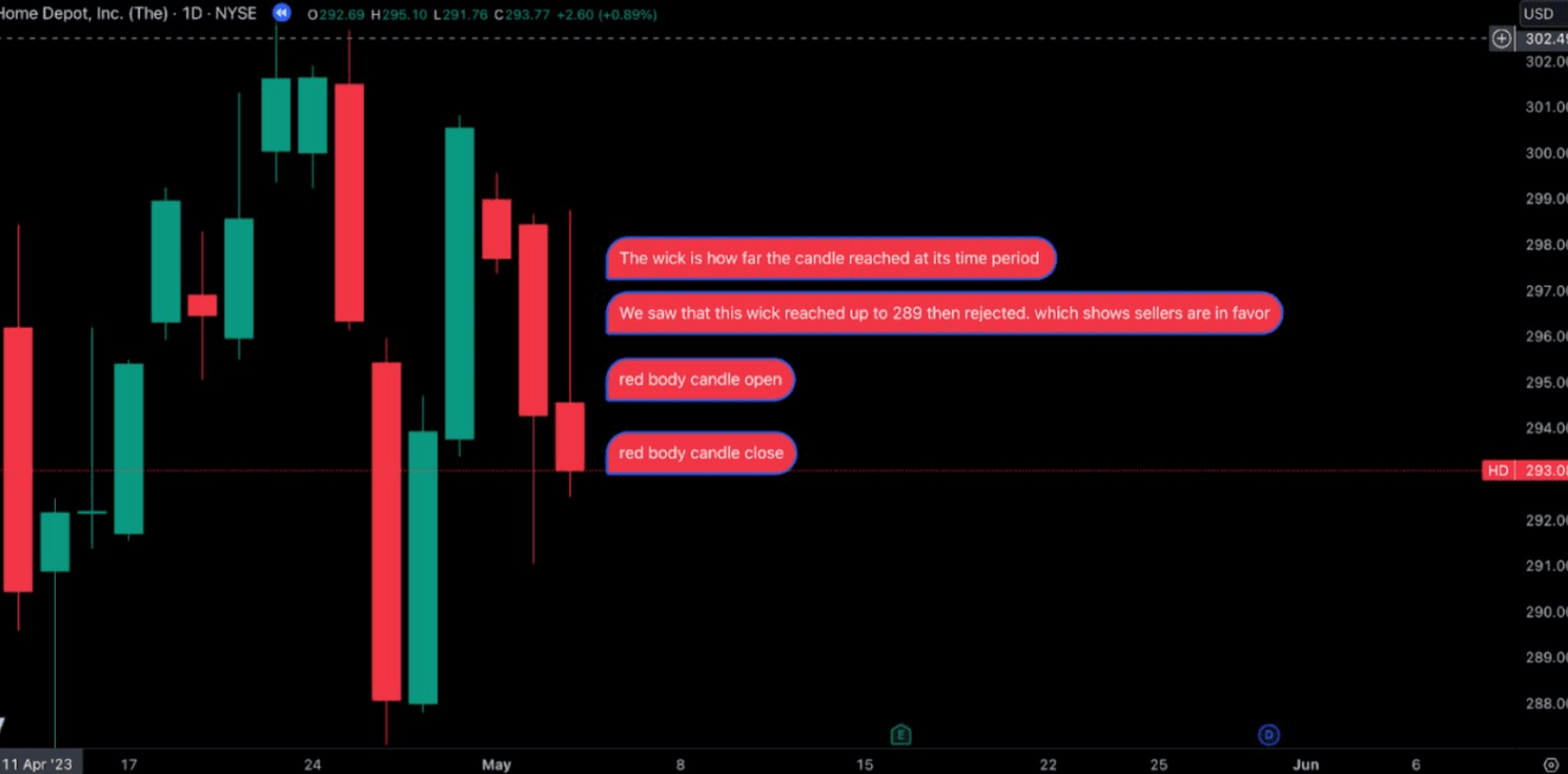
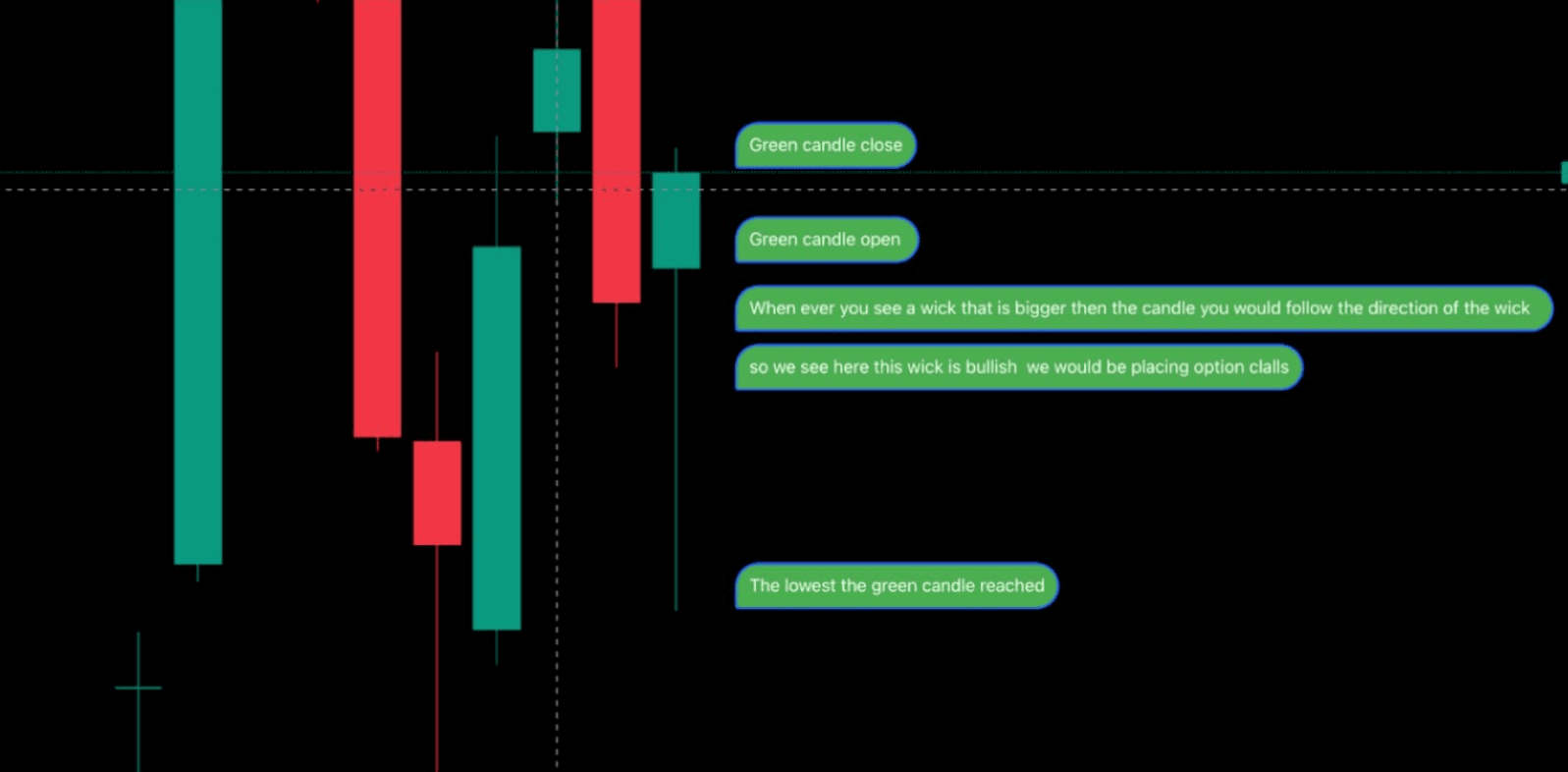
Candlesticks are the most important thing to learn when trading. Every candle tells the story of one time period: open, close, high, and low.
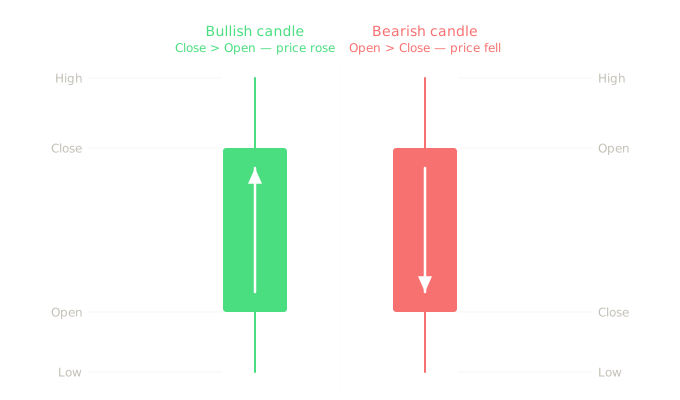
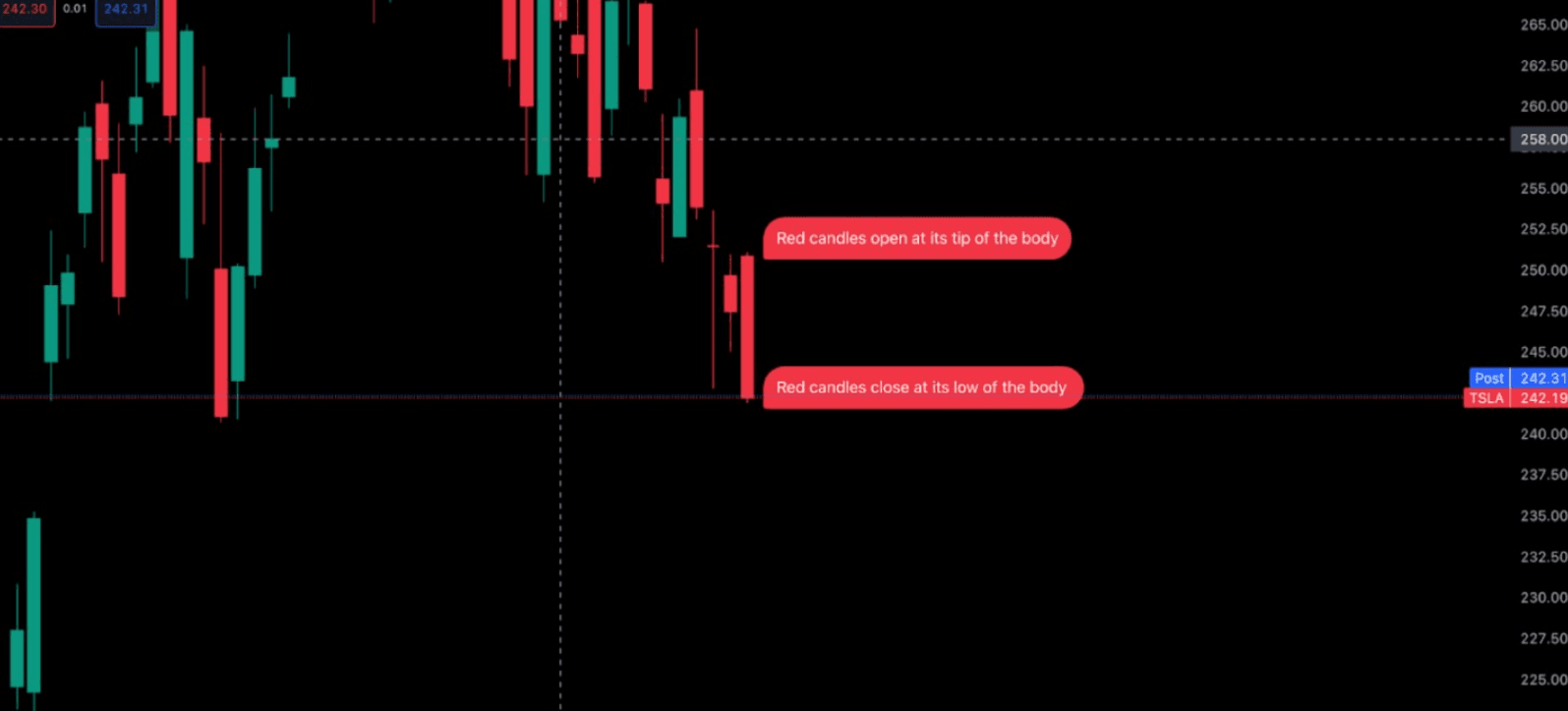
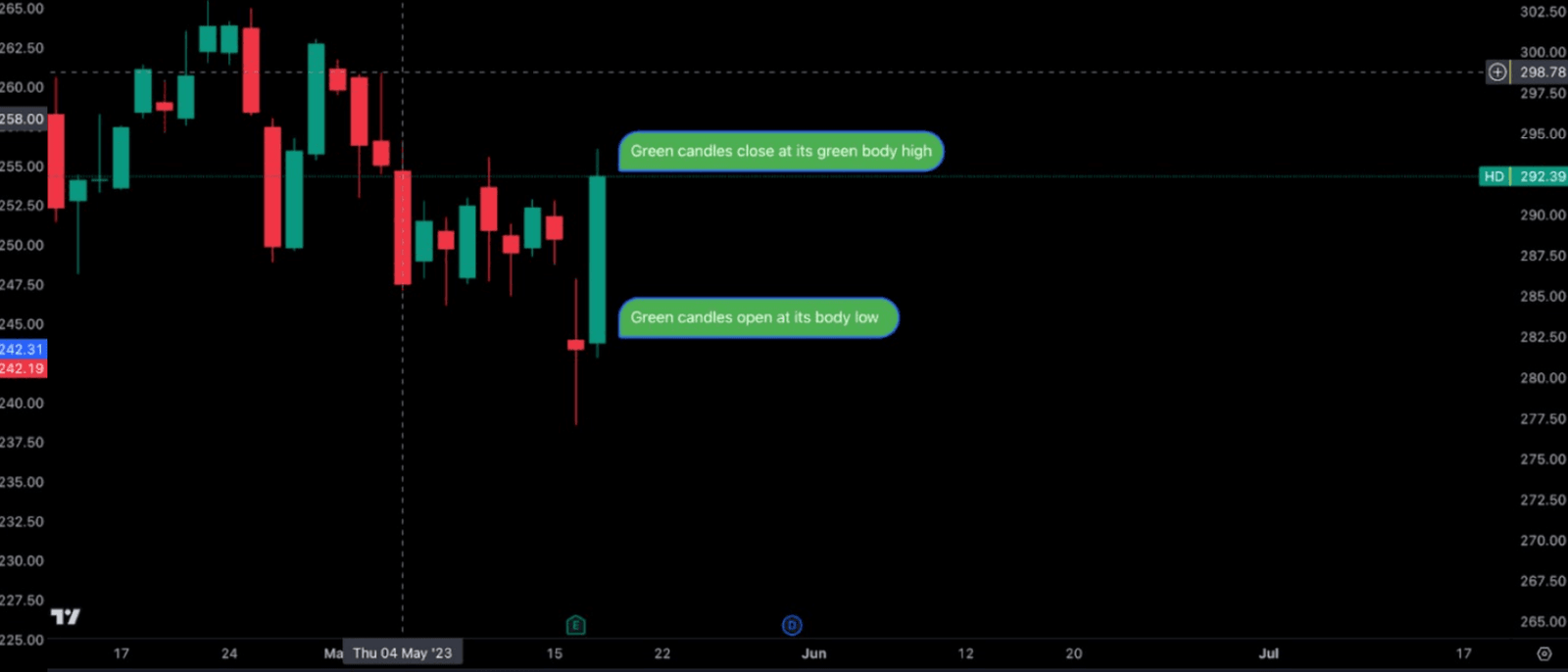
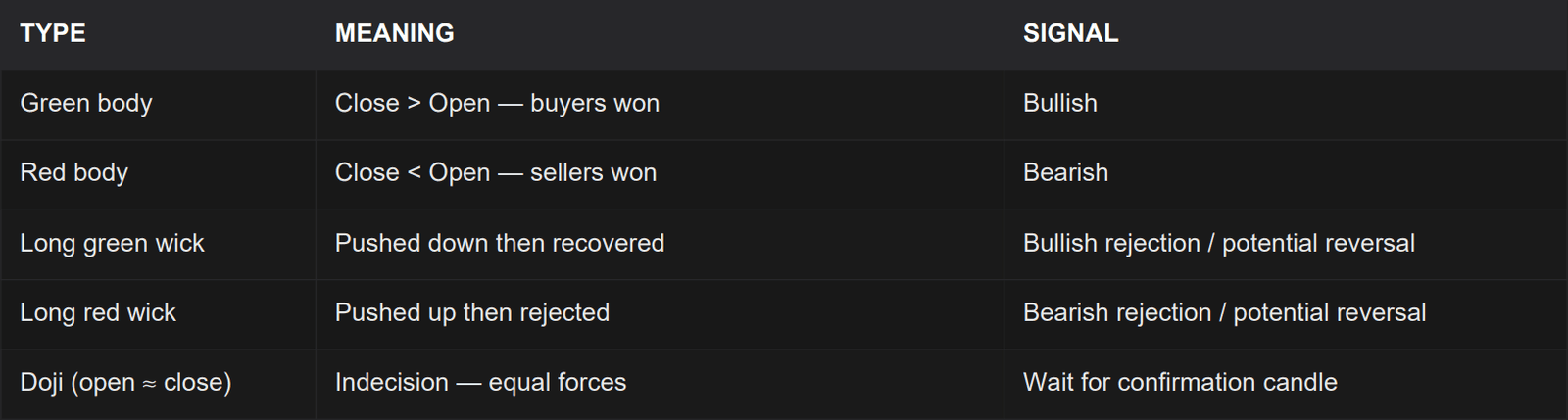
There are 4 types of candles to master:
Green body candle — price closed higher than opened (bullish)
Red body candle — price closed lower than opened (bearish)
Green body candle + wick — long wick below = buyers stepped in (bullish rejection)
Red body candle + wick — long wick above = sellers rejected (bearish rejection)
3.2 // Trading Fundamentals
Trading Psychology
This is the core of the guide. Work through these lessons in order — each concept builds on the previous. Do not skip ahead. Master these before putting real capital at risk.
Here's a couple videos that really leveled up my psychology. I highly suggest and recommend you watch these.
One of the greatest things I learned was about doing what I loved and not what I thought people would appreciate the most. I might’ve been dead broke, but knowing I was on the right track by getting those mental wins is what allowed me to see growth.
People that don’t share your vision or that live too comfortably will never understand what you do or why you do it. Our generation has no sense of urgency to do anything uncomfortable without being forced or threatened.
The habits that you build from something as simple as going to the gym directly translate into your work ethic. Crypto has never felt like a chore to me because I became obsessed with the process, the potential, and the results.
You need at least one self-improvement habit to catch a glimpse of what building your future is really about.
If you want to buy things without looking at the price, you need to be able to work without looking at the clock.
3.3 // Trading Fundamentals
Risk Management
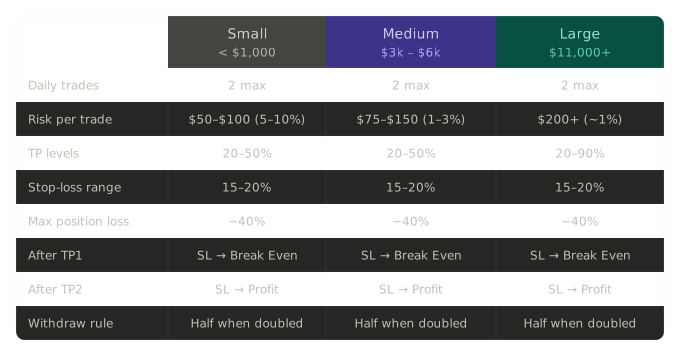
Risk management is the most crucial part of trading. You need to know: how much you’re risking per trade, when to enter, when to exit, and most importantly — where your stop loss is placed.
Risk management is the most crucial part during trading
Always know how much $ you will risk, and where your stop loss is, BEFORE entering
Always trim at every take-profit level hit — never let a winner turn into a loser
For small accounts: close your full position at first or second TP
After TP1 hit: move stop loss to break-even immediately
After TP2/TP3 hit: move stop loss into profit
Only enter A+ setups — especially on small accounts
Never let a position go beyond –40% drawdown without a stop loss
Account Tier Risk Parameters:
8:21 – Take Profit Tips
3.4 // Trading Fundamentals
Smart Money Concepts (SMC)
What is Smart Money? — Father of SMC: Inner Circle Trader (ICT)
Smart money is the capital being used by institutional investors — central banks, hedge funds, market mavens, and financial professionals. Smart money operates at a scale far greater than retail investors can match.
Understanding how smart money moves in and out of markets allows you to understand what actually influences financial markets. The most important thing to know: understanding how big money moves — over the retail money — will make you more profitable. Riding the coattails of institutional investors allows you to scoop up the ‘dumb money.’
Central banks are the most common market movers. Banks use our money to make more money — so they have a natural advantage over retail investors who are moving money within the bank’s own systems.
Step 1 of SMC — Identifying Market Structure
he whole point is identifying what the chart is telling you. Is the story strong or weak? Is the structure strong or is it breaking down?
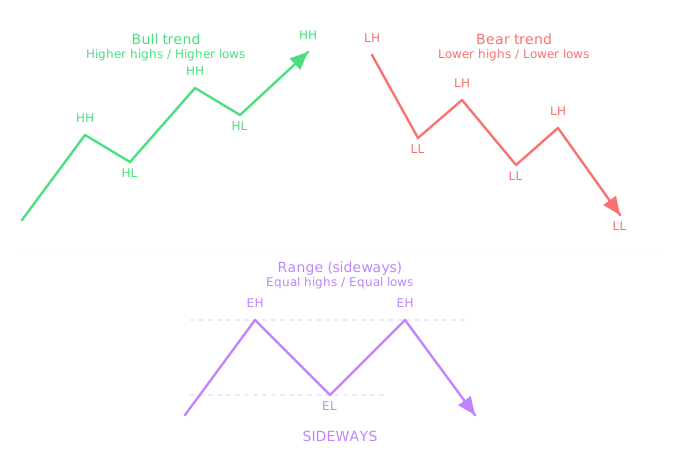
The most obvious picture is identifying the trend. In a downtrend, lower lows being created is the first good sign. But if lower highs are being broken, that is not a good sign. Every action has an equal and opposite reaction — every move has meaning behind it.
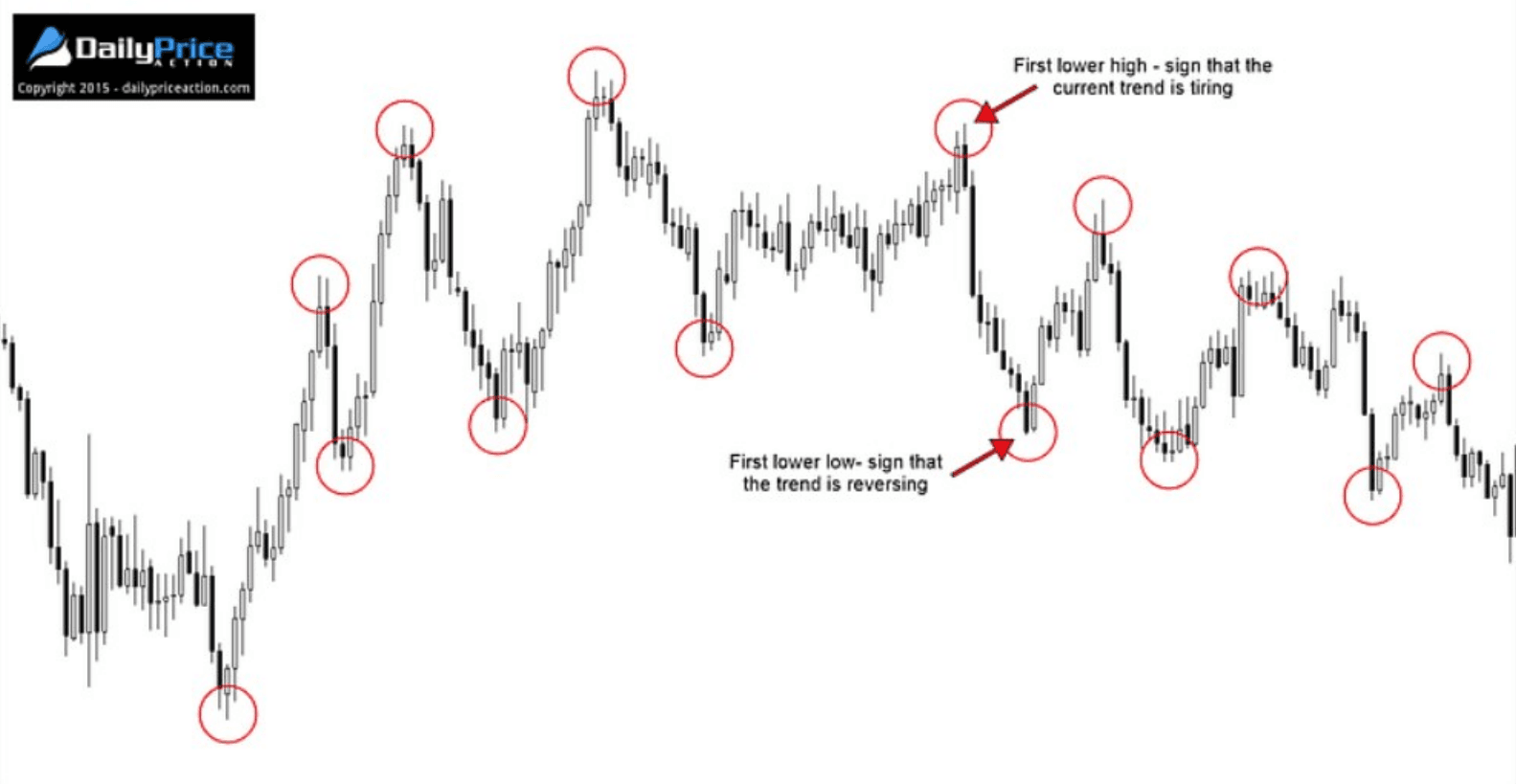
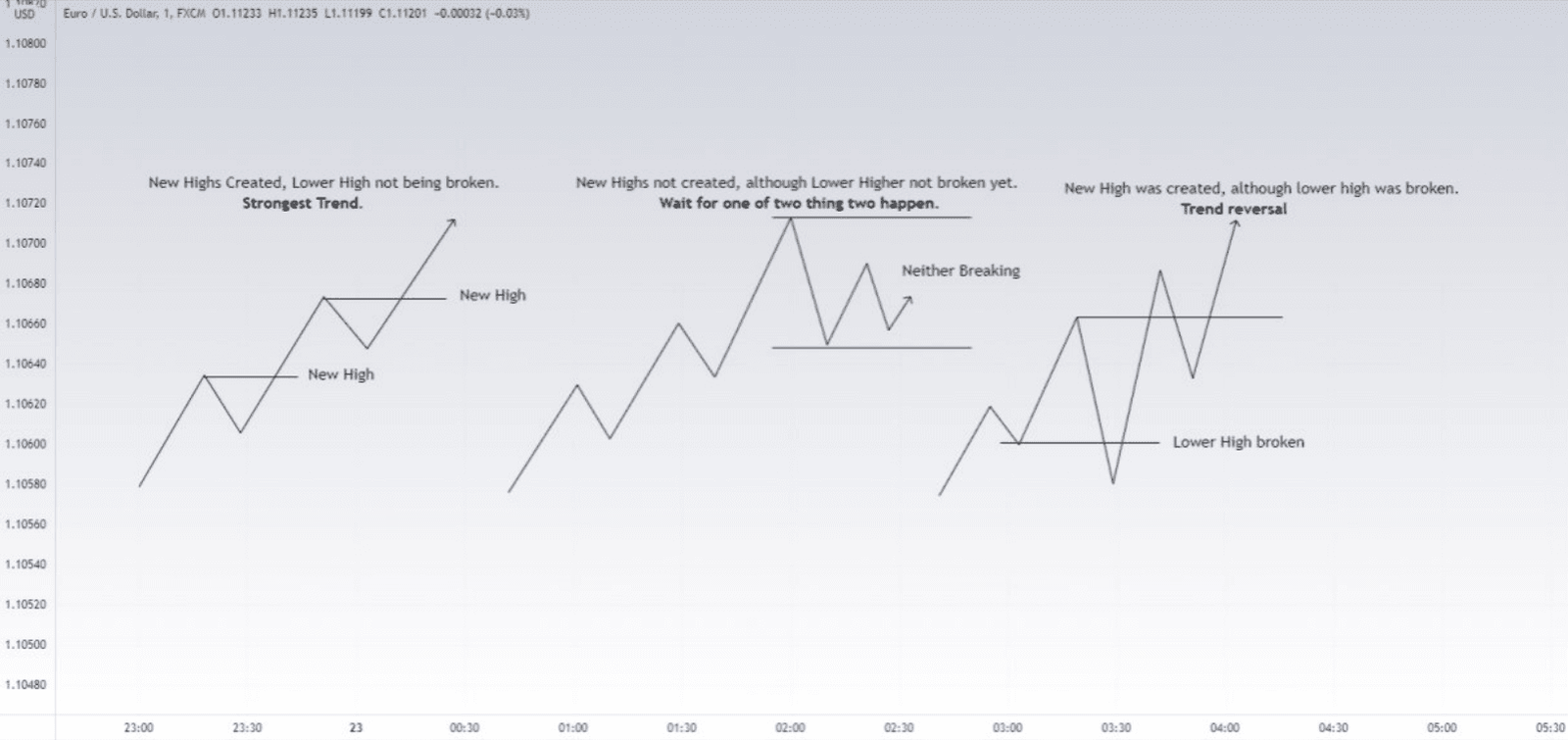
Next, identify whether the trend is strong or weakening. If we are in an uptrend and a Higher High isn’t made, it shows a weakening of the trend and a possible reversal. If the higher low hasn’t broken yet, I still wouldn’t classify it as a trend shift — wait for one of those two conditions to trigger.
To confirm a trend is strong, look for a Break of Structure (BOS): in an uptrend, price must break and close above a previous high.
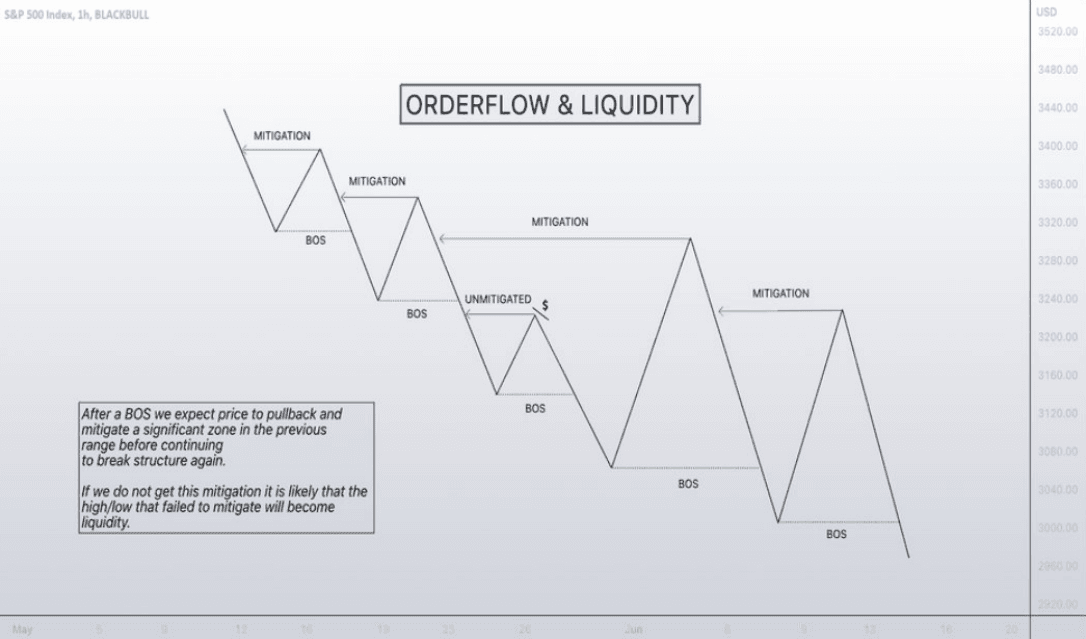
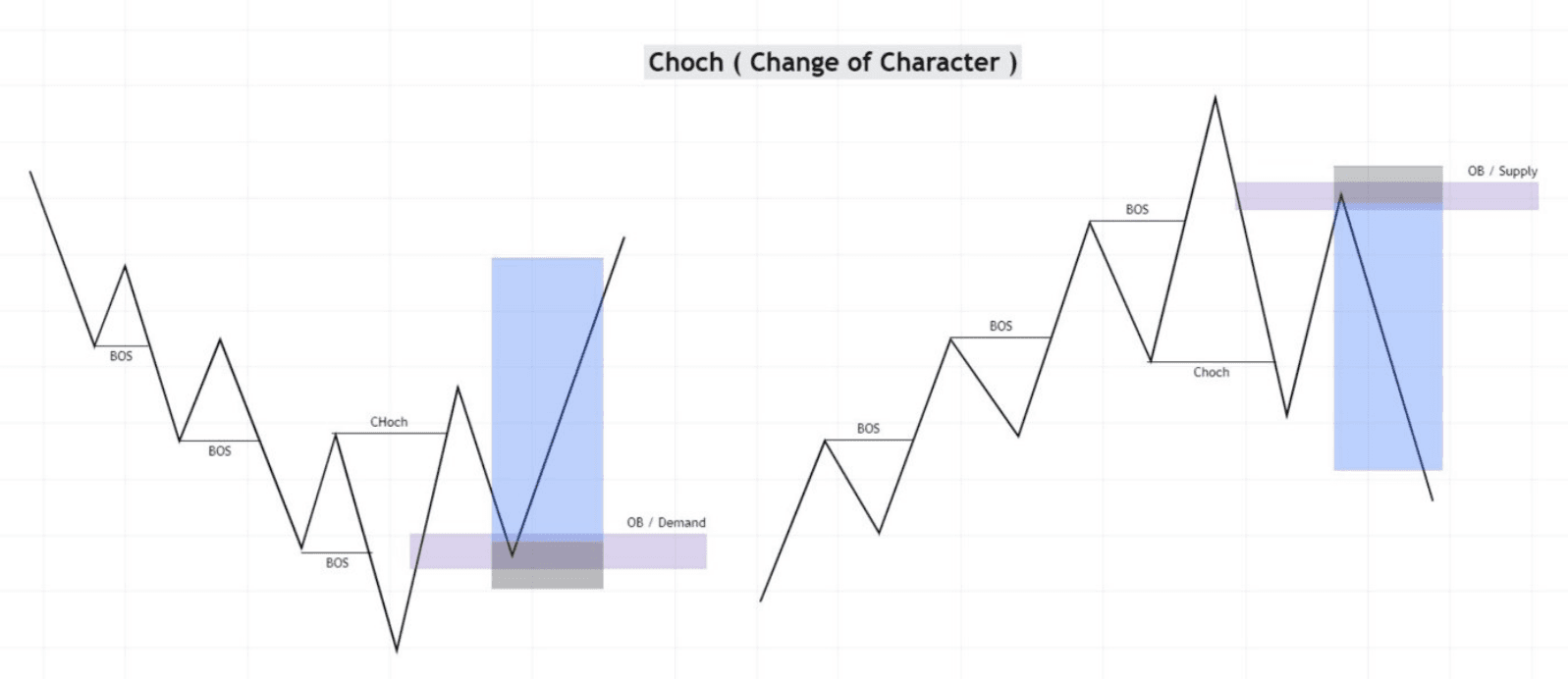
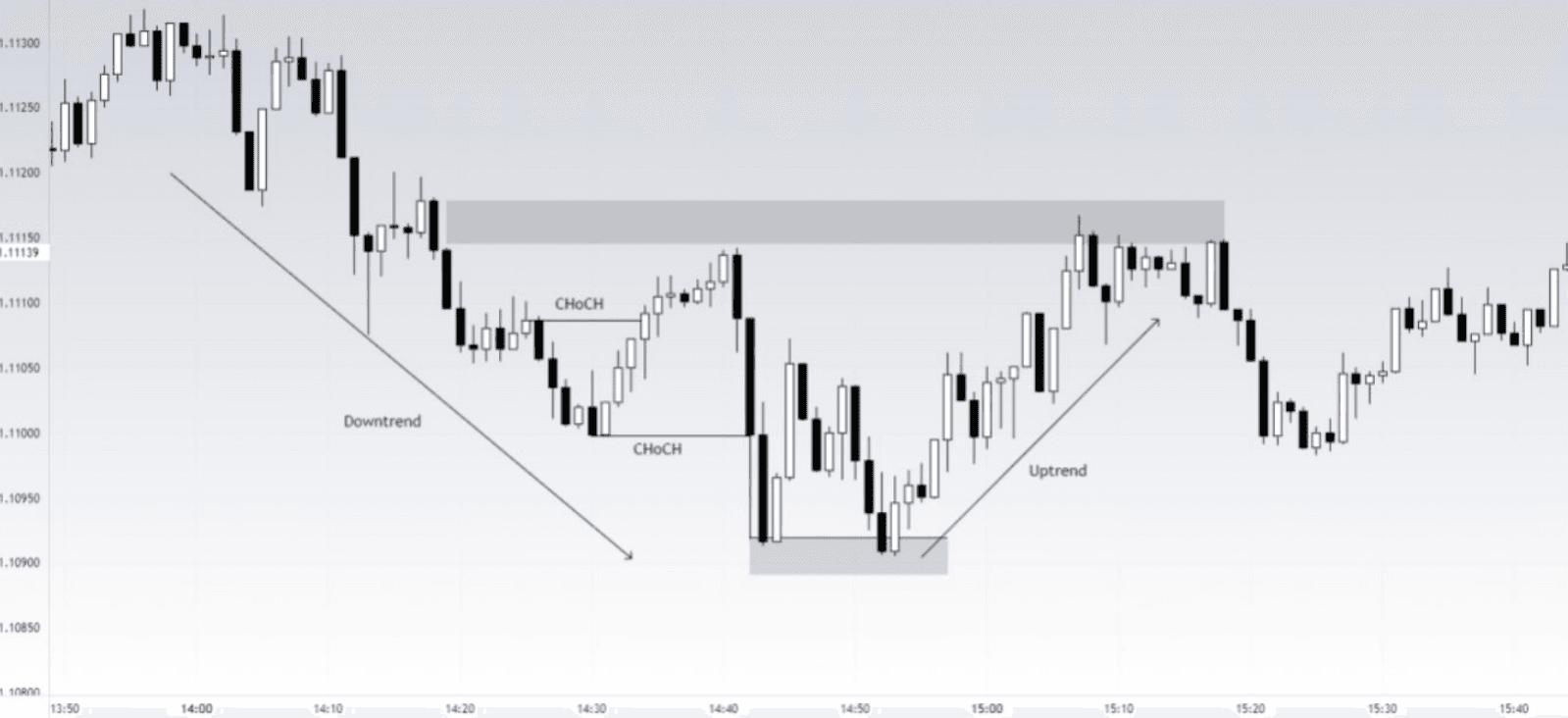
Market Structure Shift (MSS) — also called ChoCH (Change of Character)
An MSS tells us that market structure is shifting. It occurs when we are in an uptrend (making higher highs and higher lows) and price closes below the previous higher low. This signals a potential reversal or at minimum a significant pullback.
When the market fails to make a higher high, or fails to break structure, a reversal is bound to appear. A ChoCH in a downtrend occurs when price breaks the lower high and lower low, often bouncing off a liquidity pool.
3.5 // Trading Fundamentals
Order Blocks
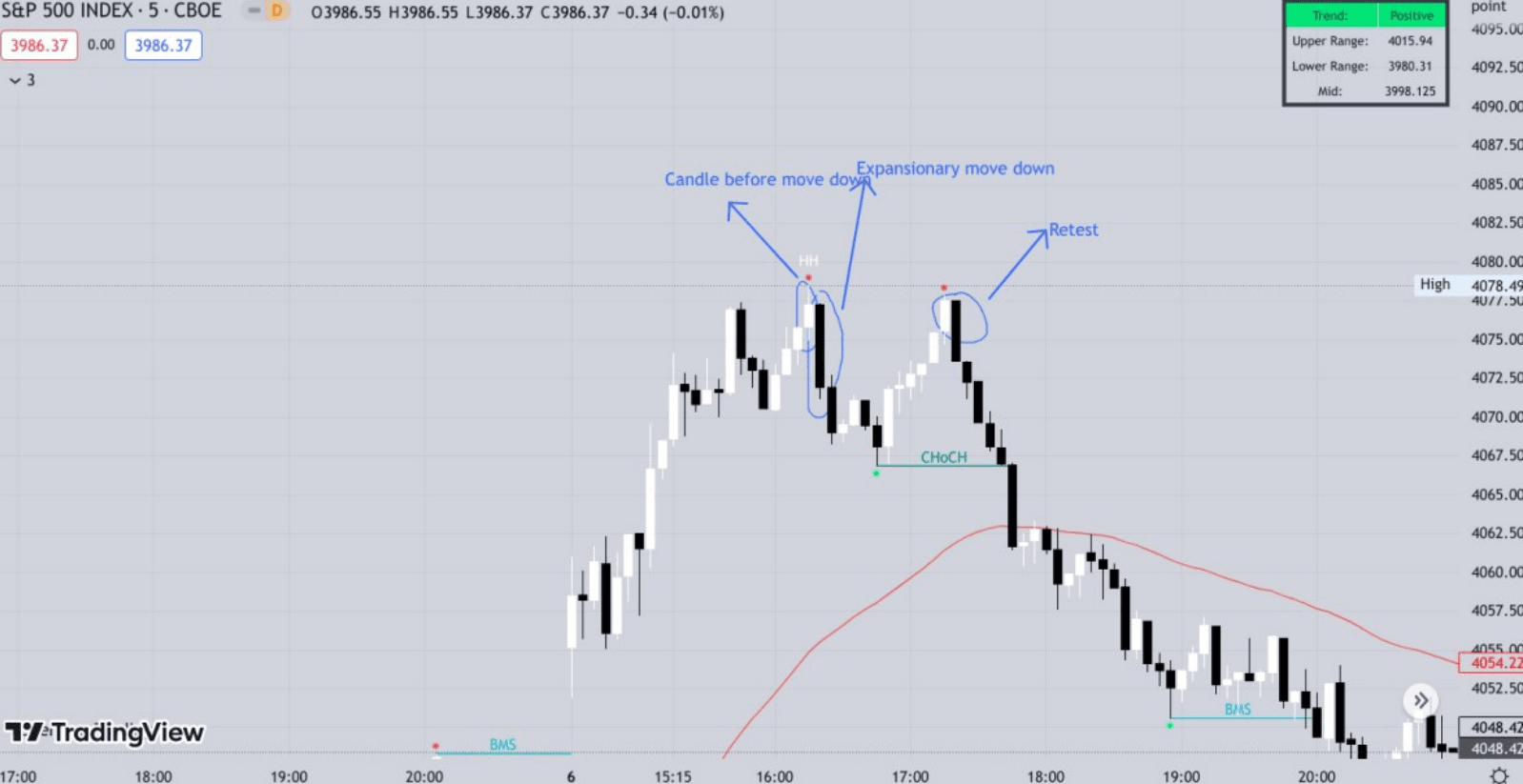
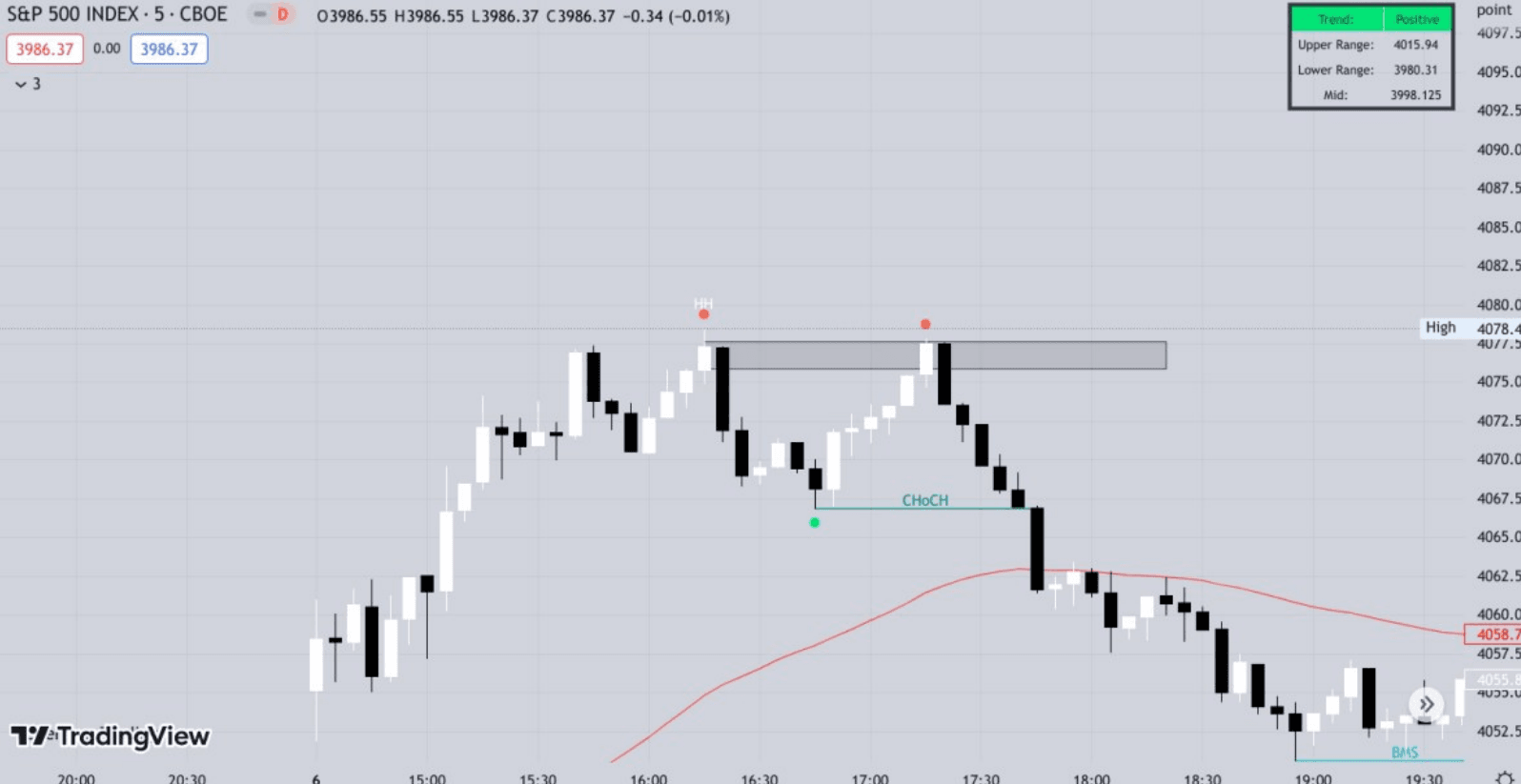
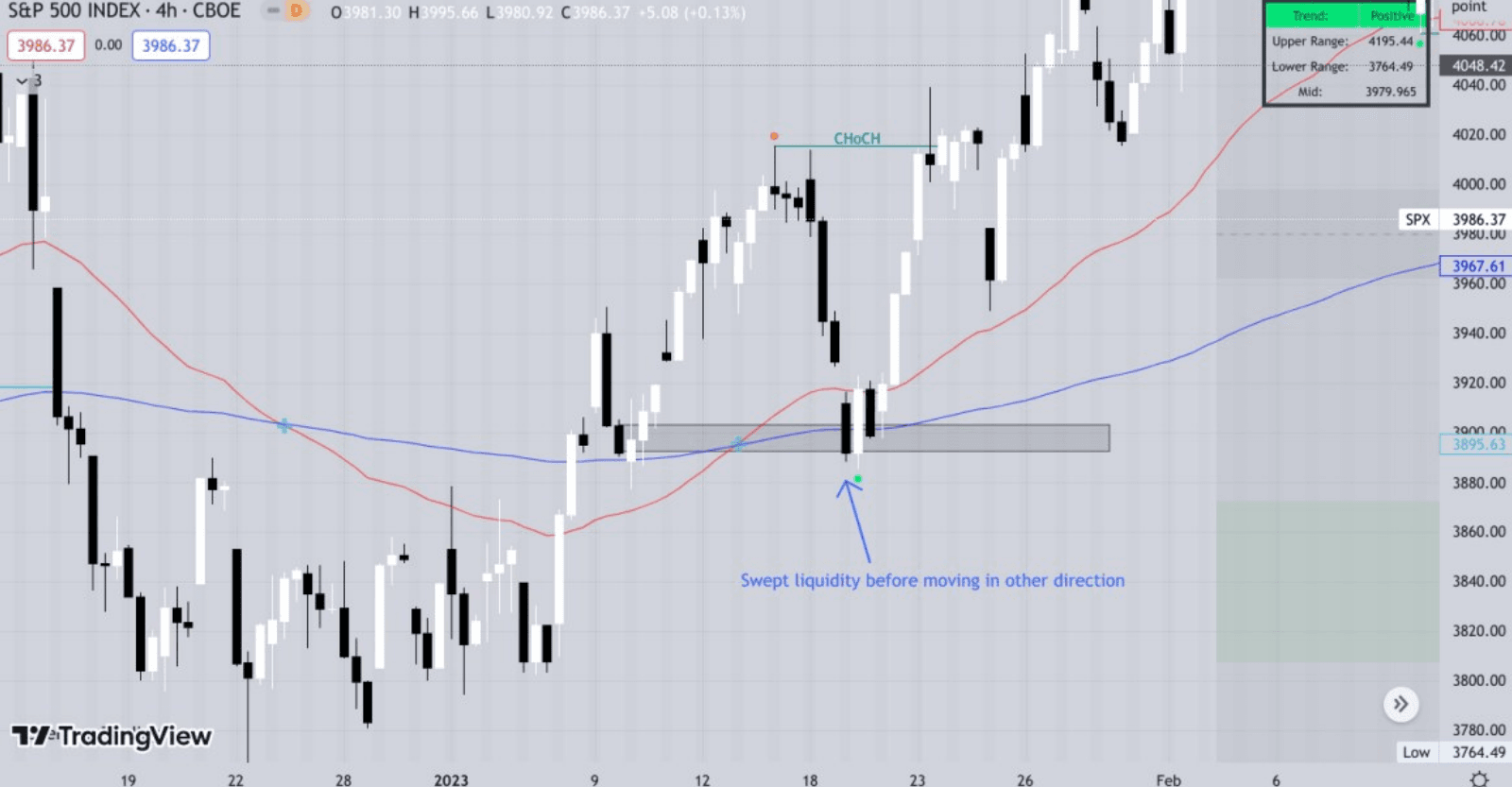
An order block is the last candle going in the opposite direction prior to a significant trend shift or expansion move.
Bullish Order Block — The lowest bearish (red) candle with the most range from open to close near a support level. Validated when a later candle trades through its high.
Bearish Order Block — The highest bullish (green) candle before a strong bearish move. Used for short entries. Order blocks indicate high-probability zones for entries and risk management in both directions.
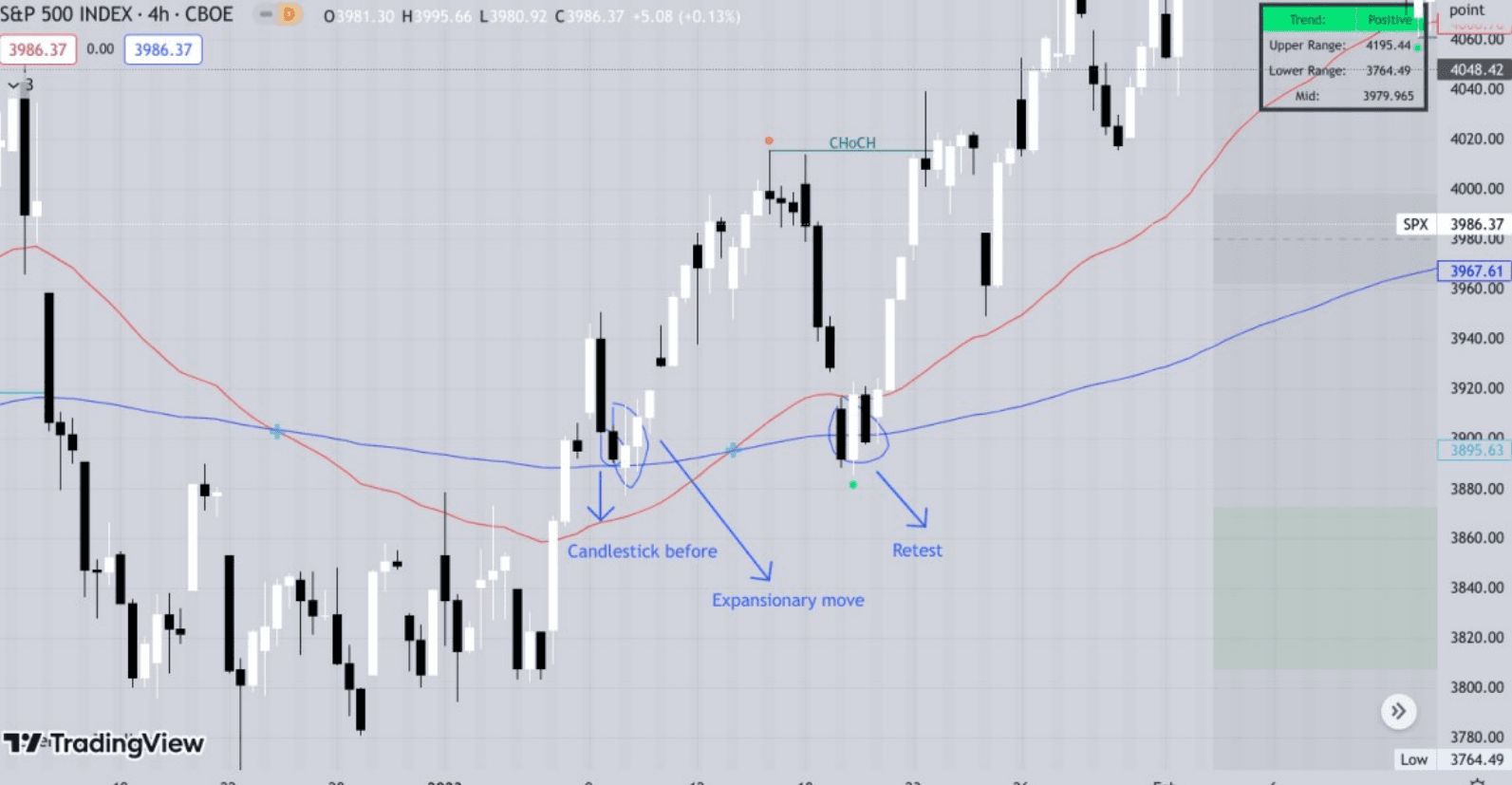
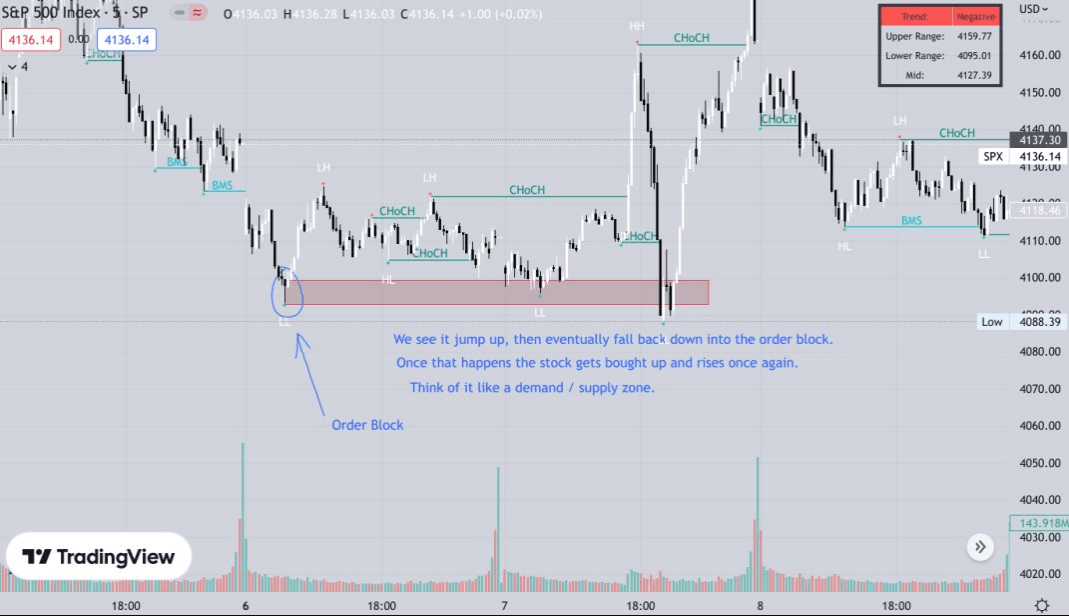
7:37 – Stop Loss Tips
5-minute and 15-minute OBs tend to be most reliable
1-minute works but breaks easily
Higher timeframe OBs carry more weight
Price does not always sweep liquidity or retest OBs — common but not guaranteed
3.6 // Trading Fundamentals
Liquidity
Liquidity in the market is found in areas where cash (stop-losses) are being held. Institutional traders hunt these levels — sweeping them before reversing. Understanding liquidity lets you predict where price is likely to go before making its real move.
Buyside Liquidity (BSL): Above previous highs — where short sellers' stop losses sit
Sellside Liquidity (SSL): Below previous lows — where long traders' stop losses sit
After a liquidity sweep, price typically reverses sharply
Key levels: Monthly H/L, Yearly H/L, Daily H/L, Hourly H/L, Pre-market H/L
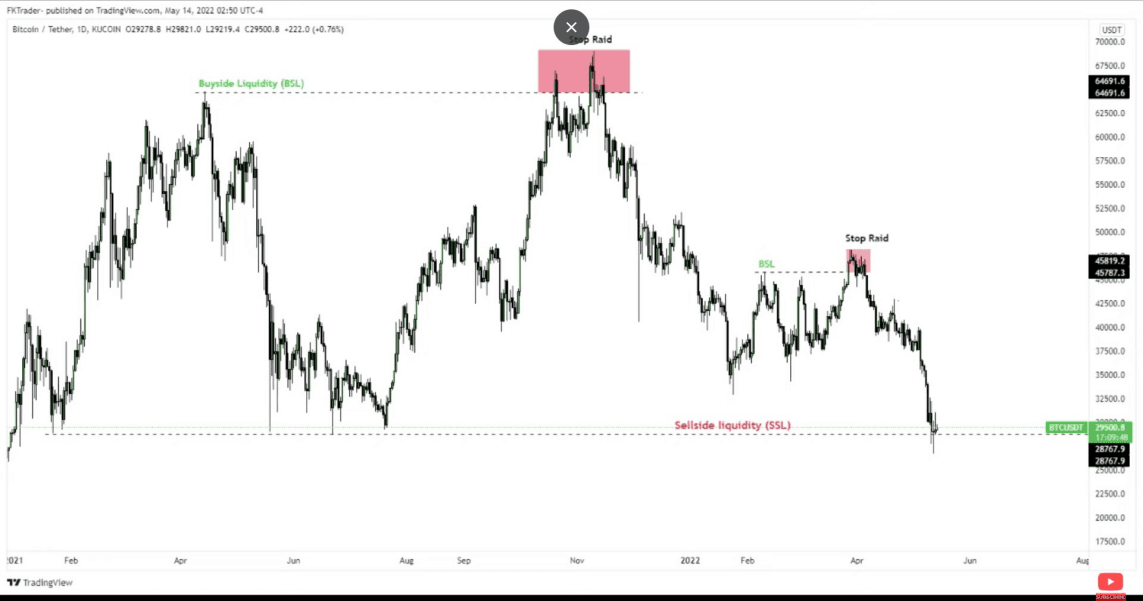
3:20 – Liquidity Sweep/Range Sweep
3.7 // Trading Fundamentals
Fair Value Gaps (FVG)
Fair Value Gaps — also known as imbalances — are price ranges where orders were accumulated so quickly that a gap formed. The market almost always returns to fill this imbalance before continuing its direction.
FVGs tend to appear after one candlestick breaks and closes through a support or resistance level. They work in a three-candlestick sequence:
◆ First Candle — Bottom of the first candle's wick
Second Candle — The space where no other candles are touching (the gap itself)
Third Candle — Top of the third candle's wick
FVG zone = the space between the wick of candle 1 and the wick of candle 3
FVGs almost always get retested to fill the imbalance before continuing
Can be used as entries, take-profit targets, or stop-loss references
Found on any timeframe — higher timeframe FVGs are stronger
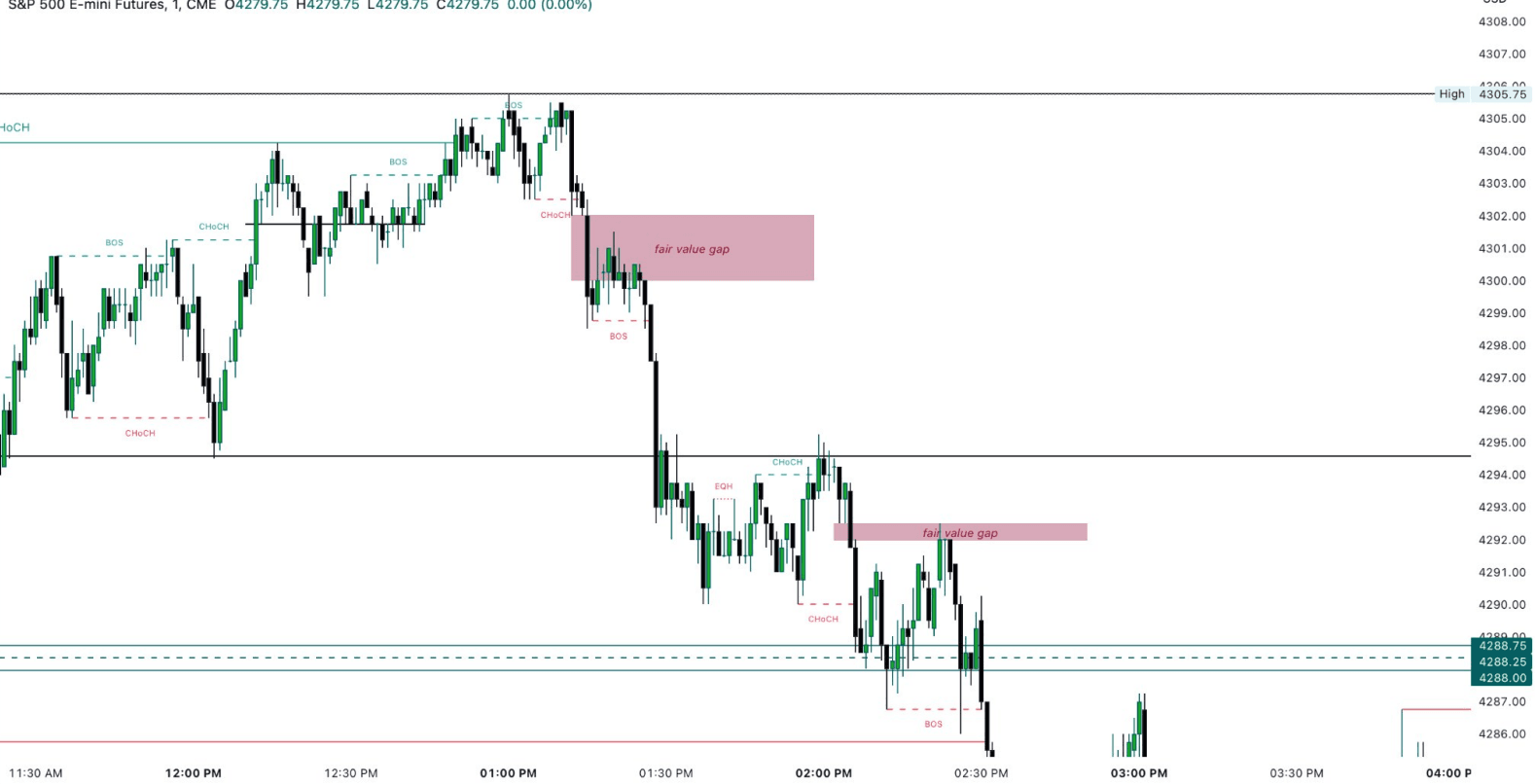
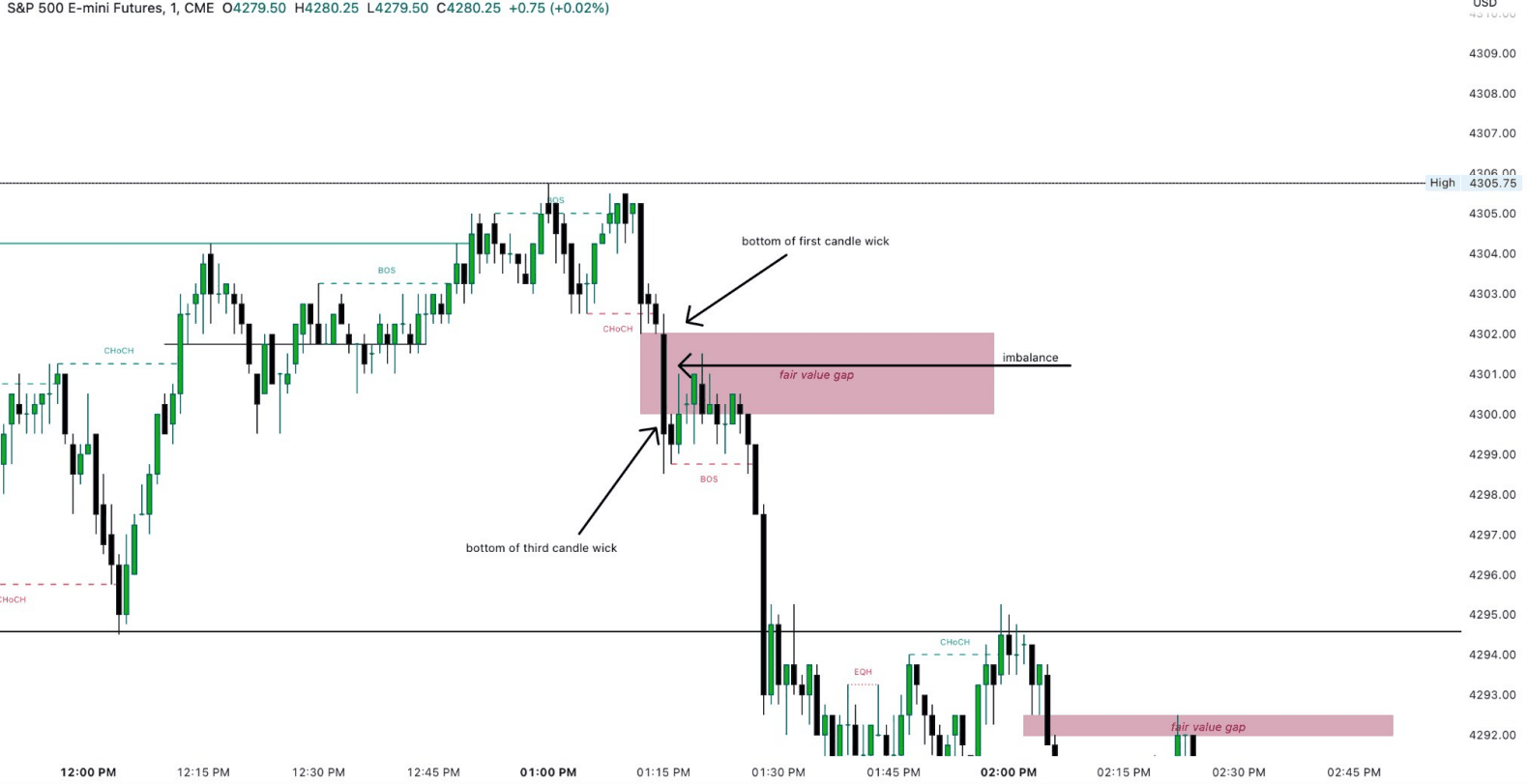
2:03 – Fair Value Gap
3.8 // Trading Fundamentals
SMT Divergance
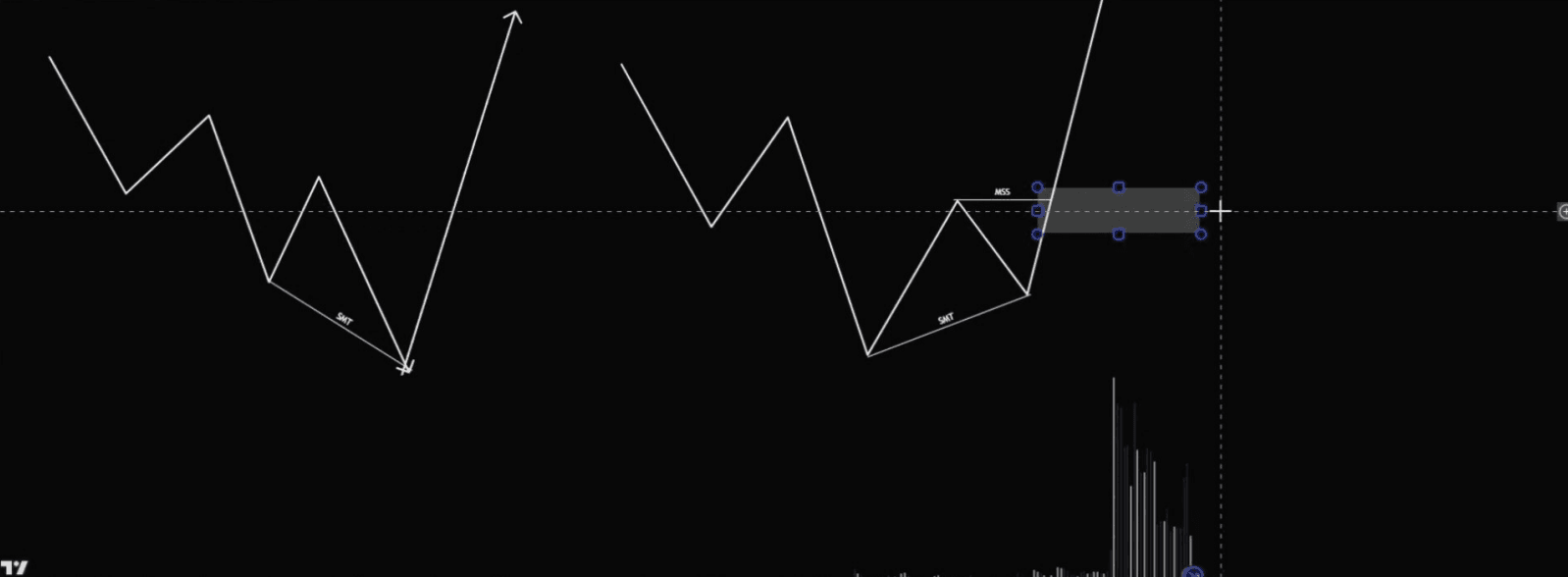
An SMT (Smart Money Tool) Divergence is a divergence between two correlated assets — when one makes a new high/low but its correlated pair does not. This signals institutional manipulation and often precedes a sharp reversal.
Bearish SMT: One asset makes a Higher High (HH) while the correlated asset makes a Lower High (LH). Can be found at highs when one asset took out a liquidity point while the other lags behind.
Bullish SMT: One asset makes a Lower Low (LL) while the correlated asset makes a Higher Low (HL). Indicates smart money accumulating — a reversal upward is likely.
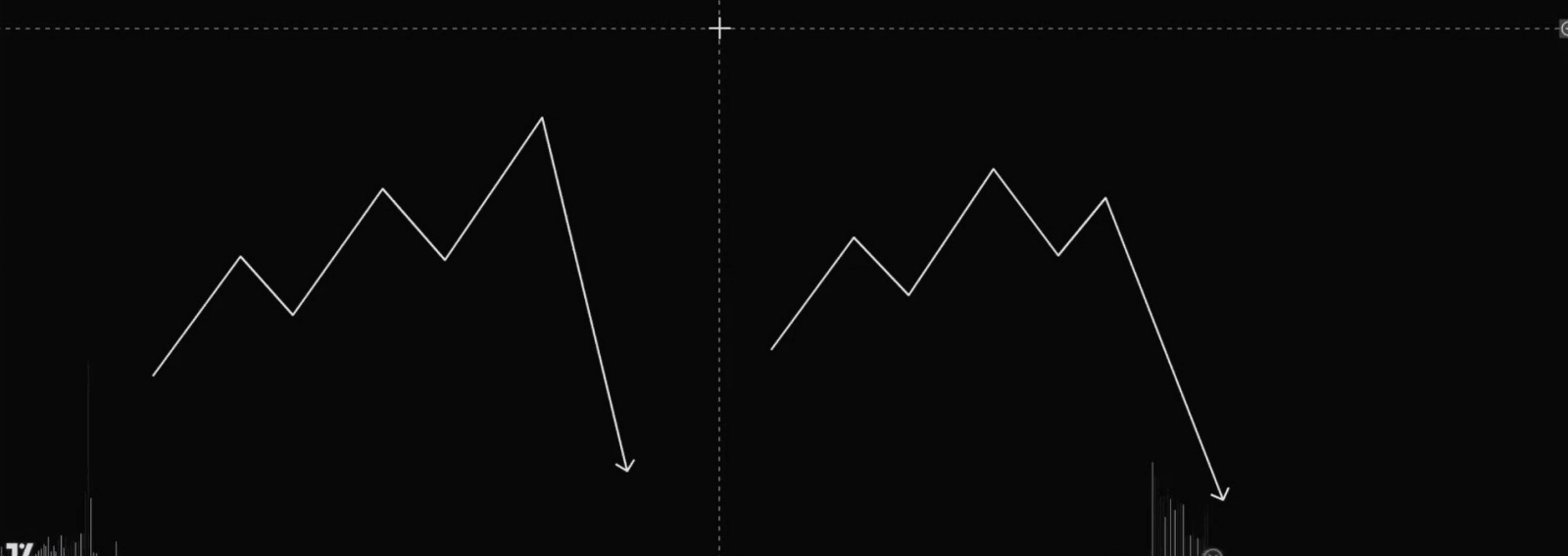
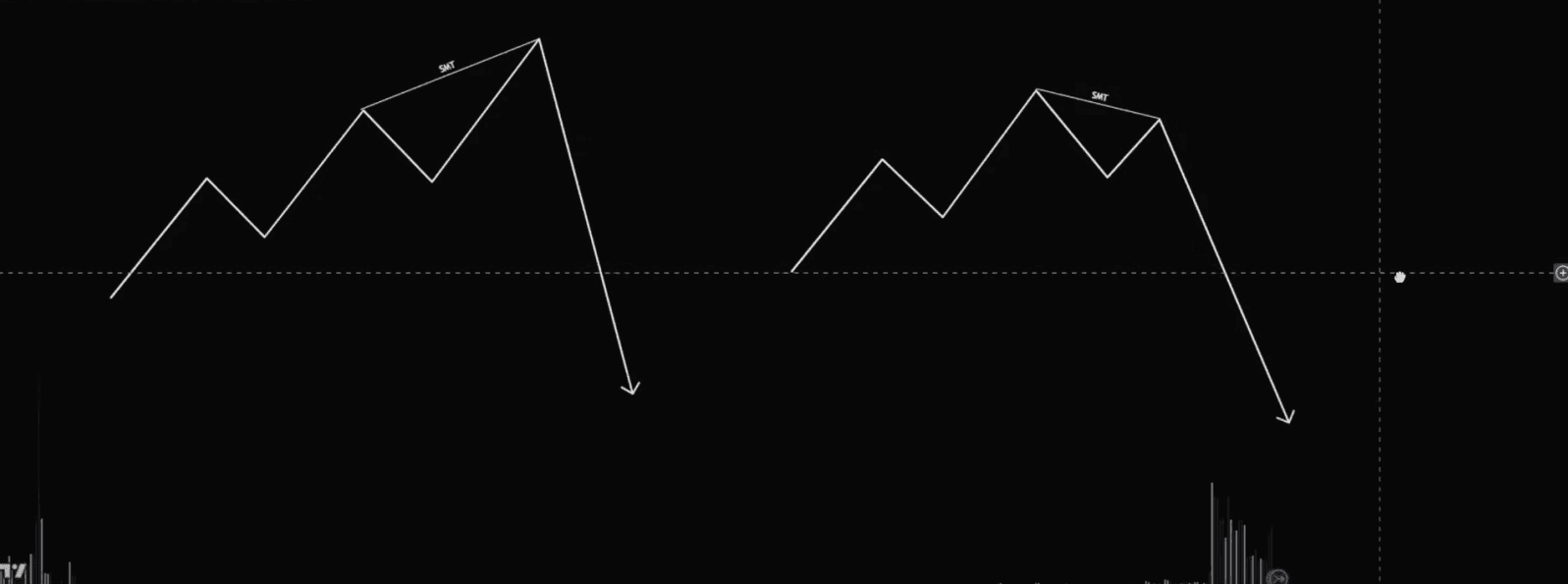
After the SMT forms, take longs or shorts once you see an MSS, or wait for a retracement into an FVG.
Example: ES takes out a low while NQ does not — bullish SMT. On lower timeframes (1m or 5m), you can enter once you see a Direction of Liquidity (DOL) and price retraces into an FVG. Target the previous high or low.
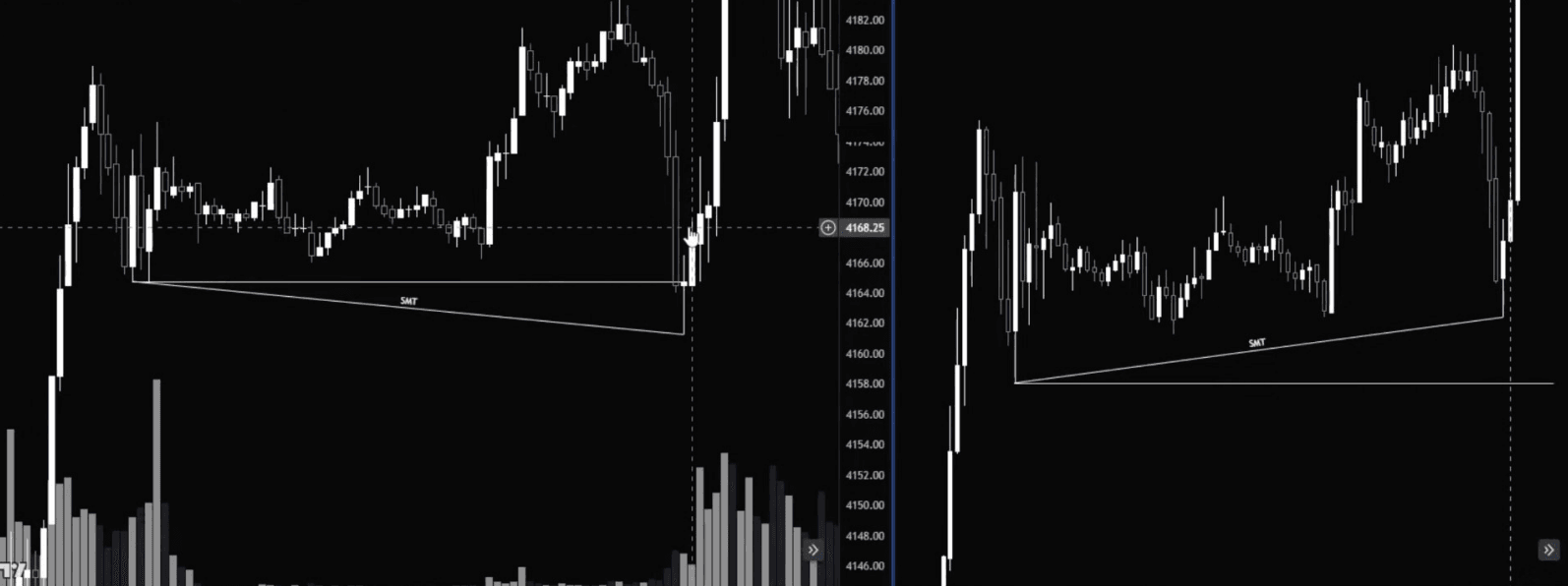
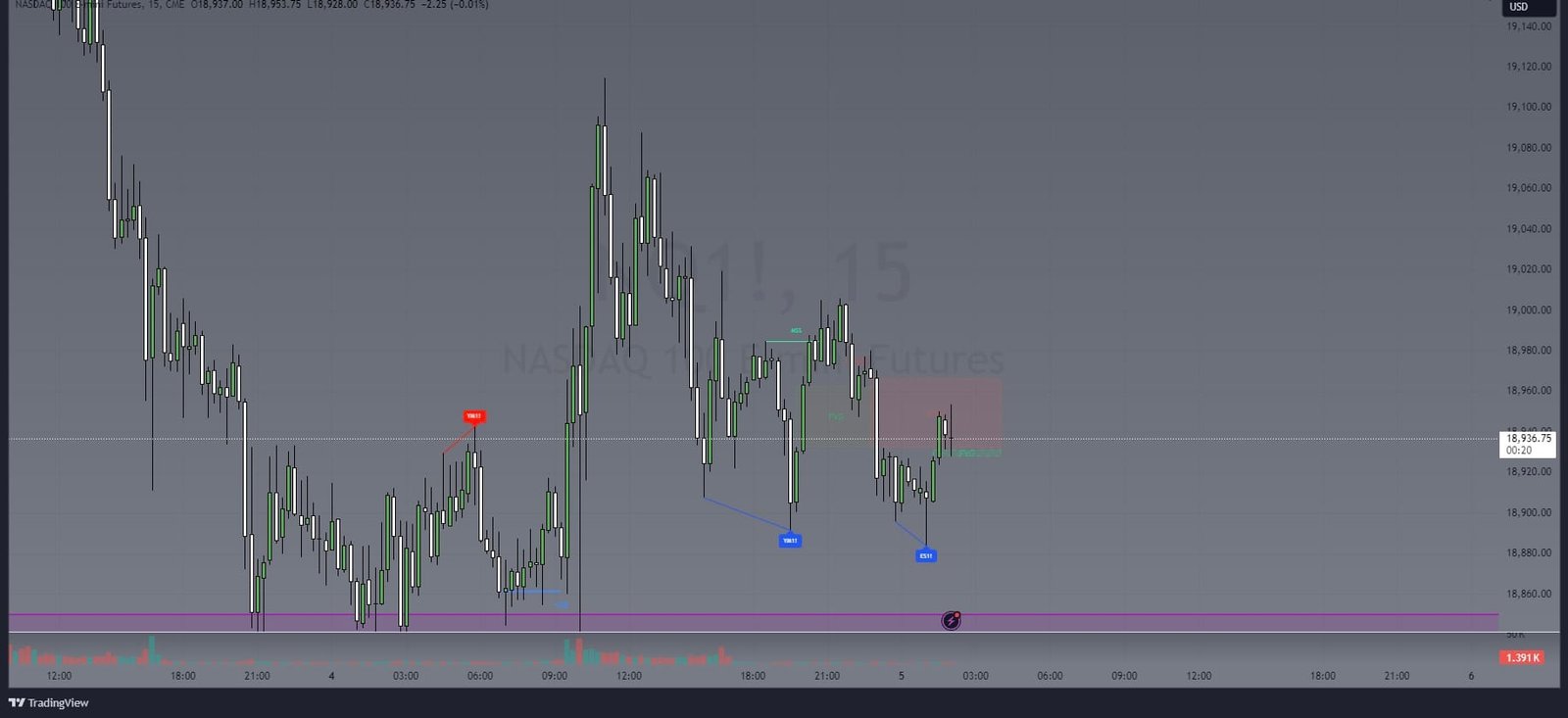
Strongest SMTs on 15-minute timeframe and above
Still valid on 1-minute and 5-minute charts
After SMT: enter on MSS or on retracement into FVG
Target: previous swing high or low
Crypto pairs to watch: BTC/ETH, SOL/BTC, correlated altcoins
0:41 – The SMT
3.9 // Trading Fundamentals
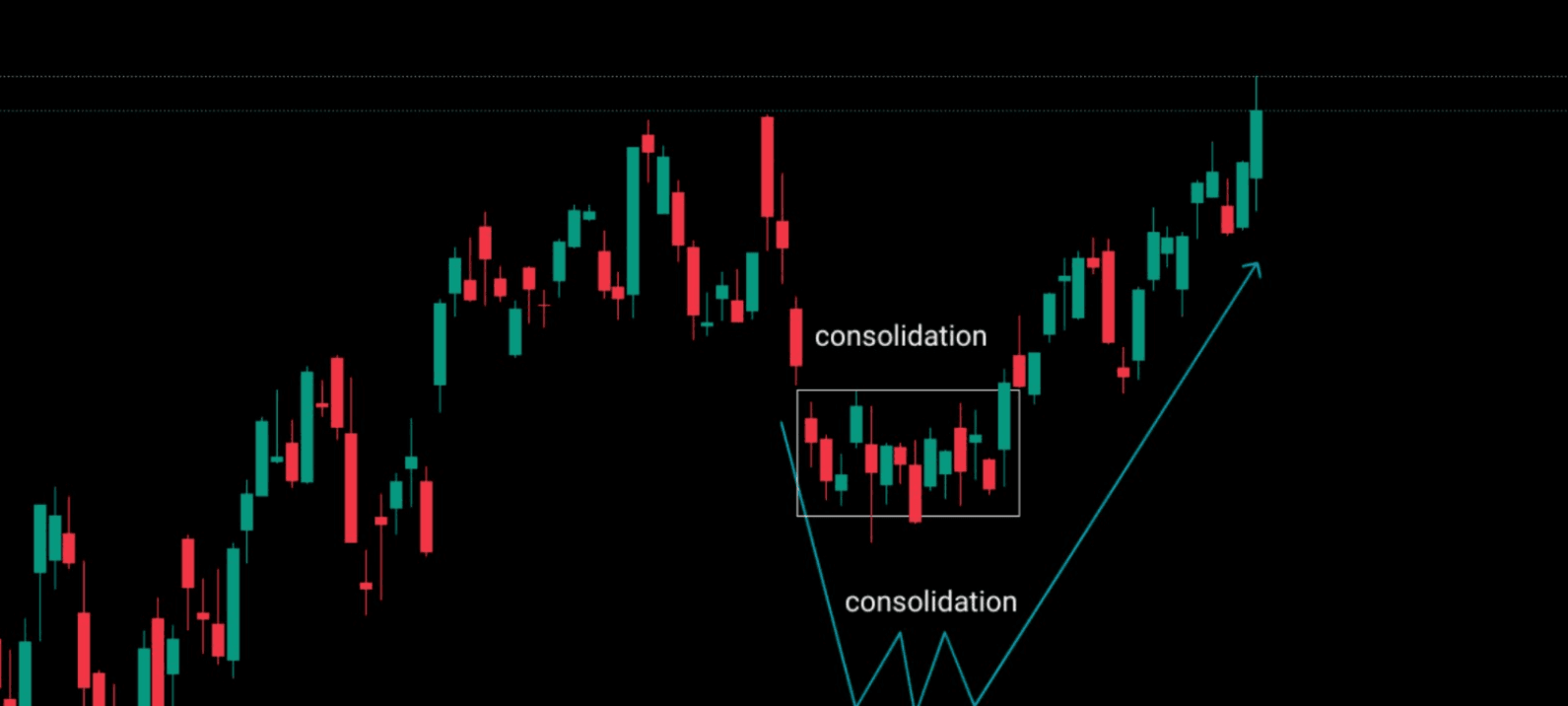
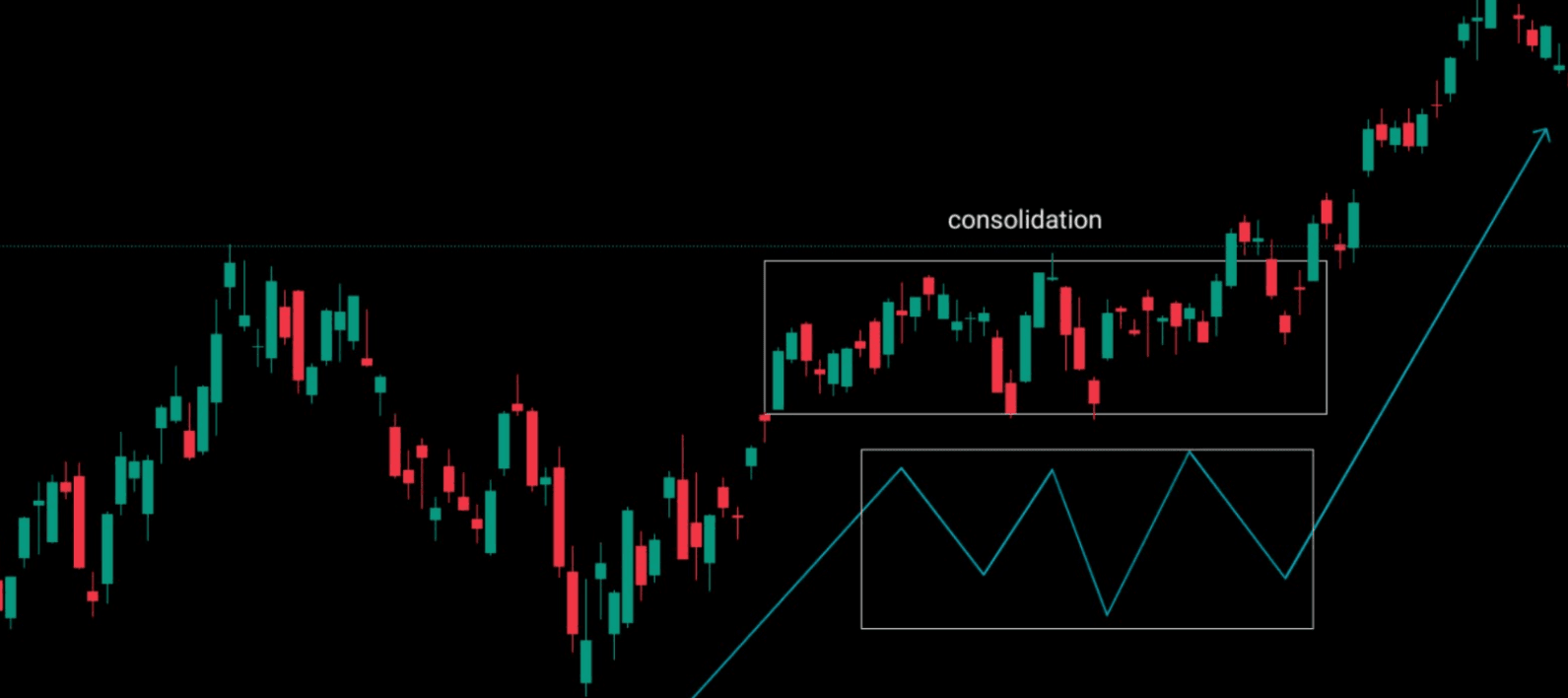
Consolidation
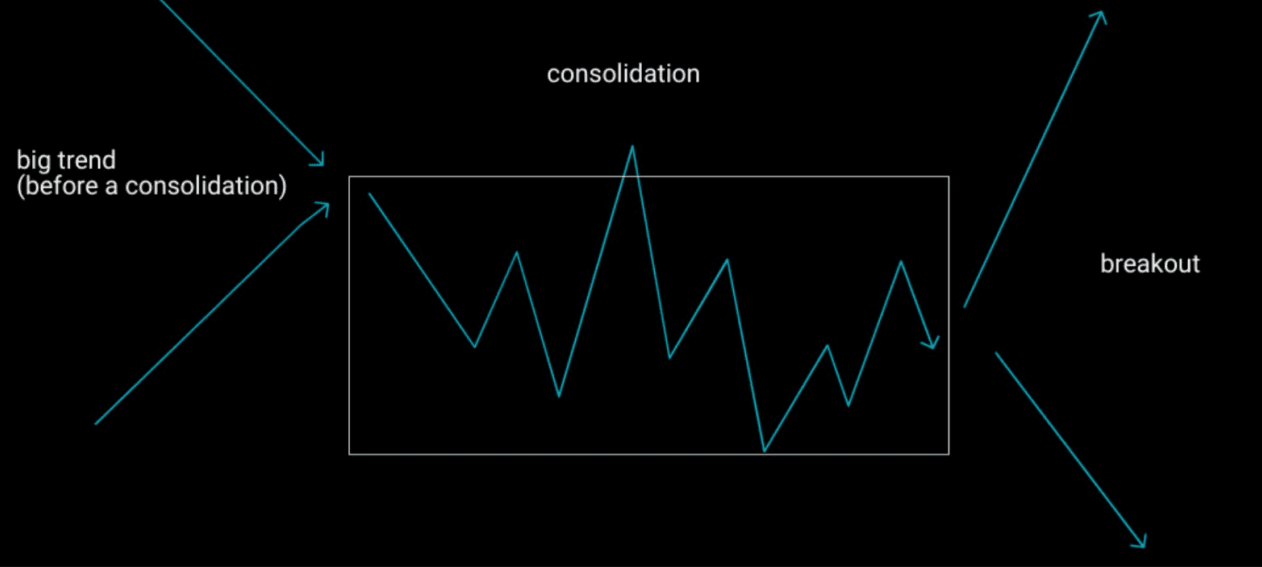
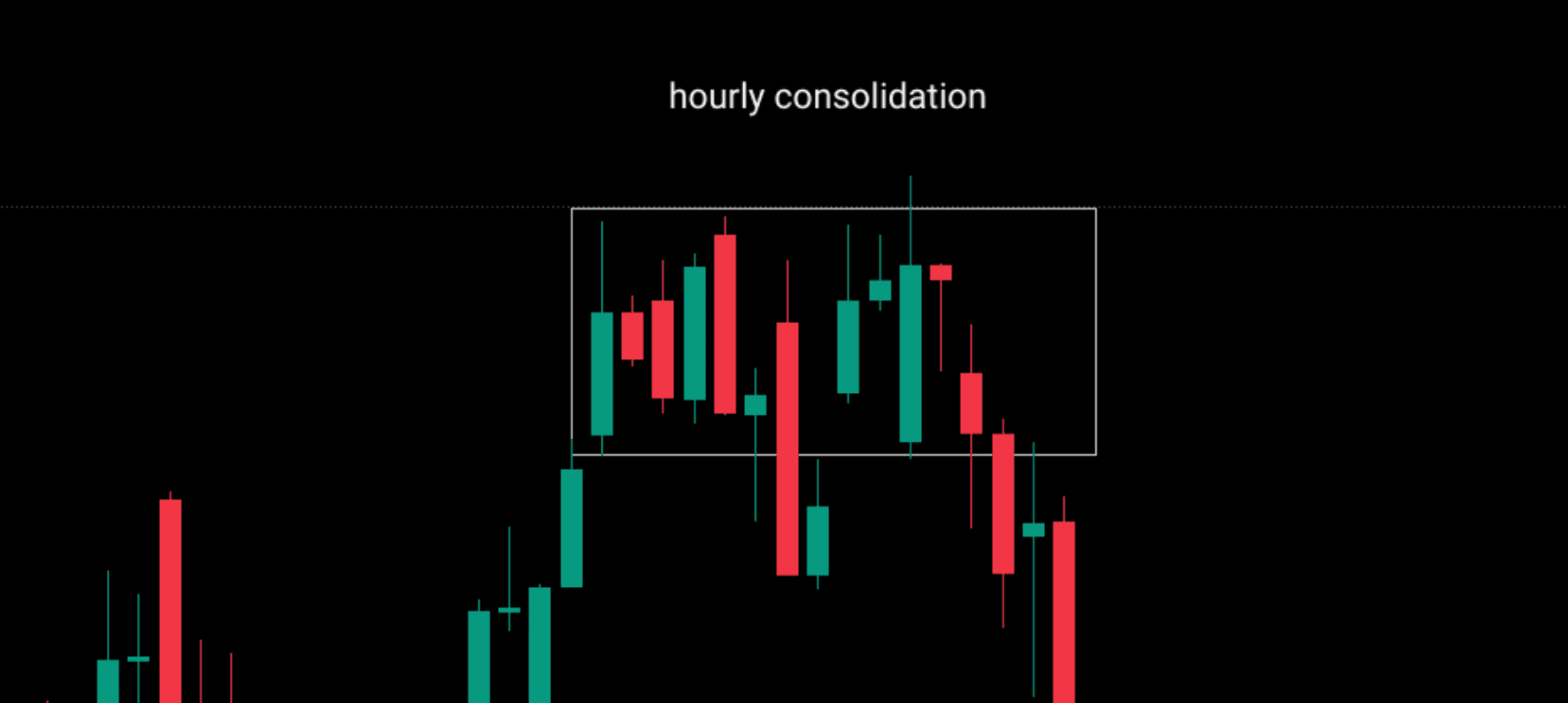
Consolidations are periods of sideways price action between two key levels, typically forming after a strong trend as the market accumulates orders before breaking in one direction.
Consolidations normally last from a couple of hours to several days
There is always a trend before and after a consolidation
Consolidations form when price is on major support and resistance
Trade the breakout in the direction of the prior trend
3.10 // Trading Fundamentals
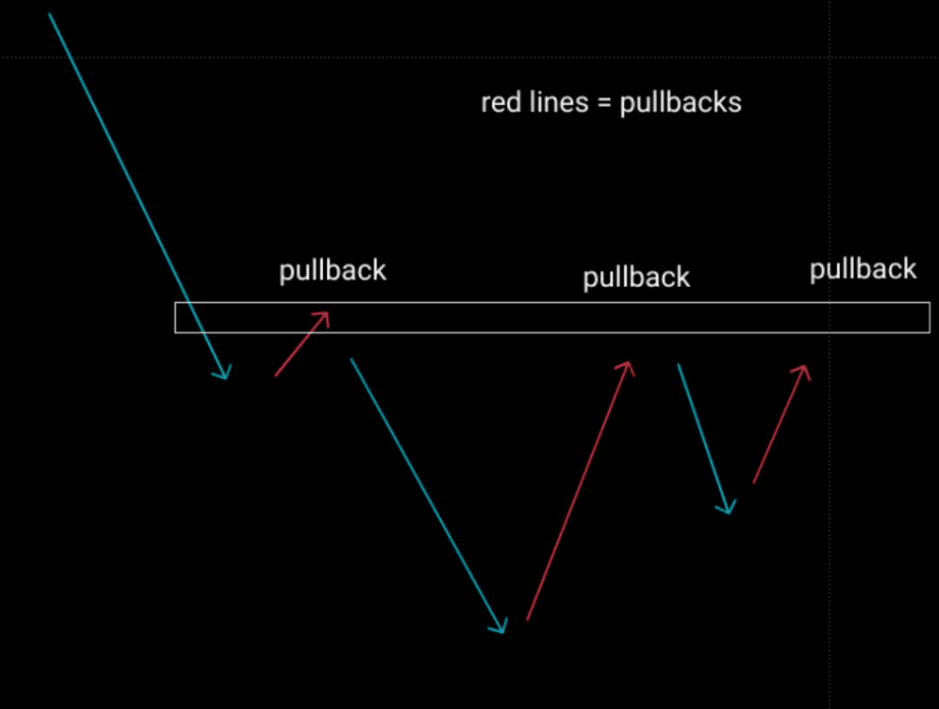
Pullbacks
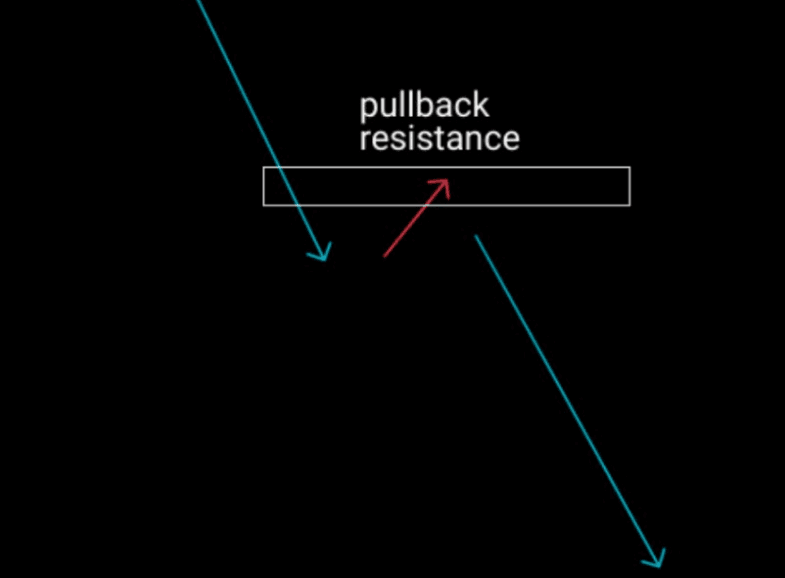
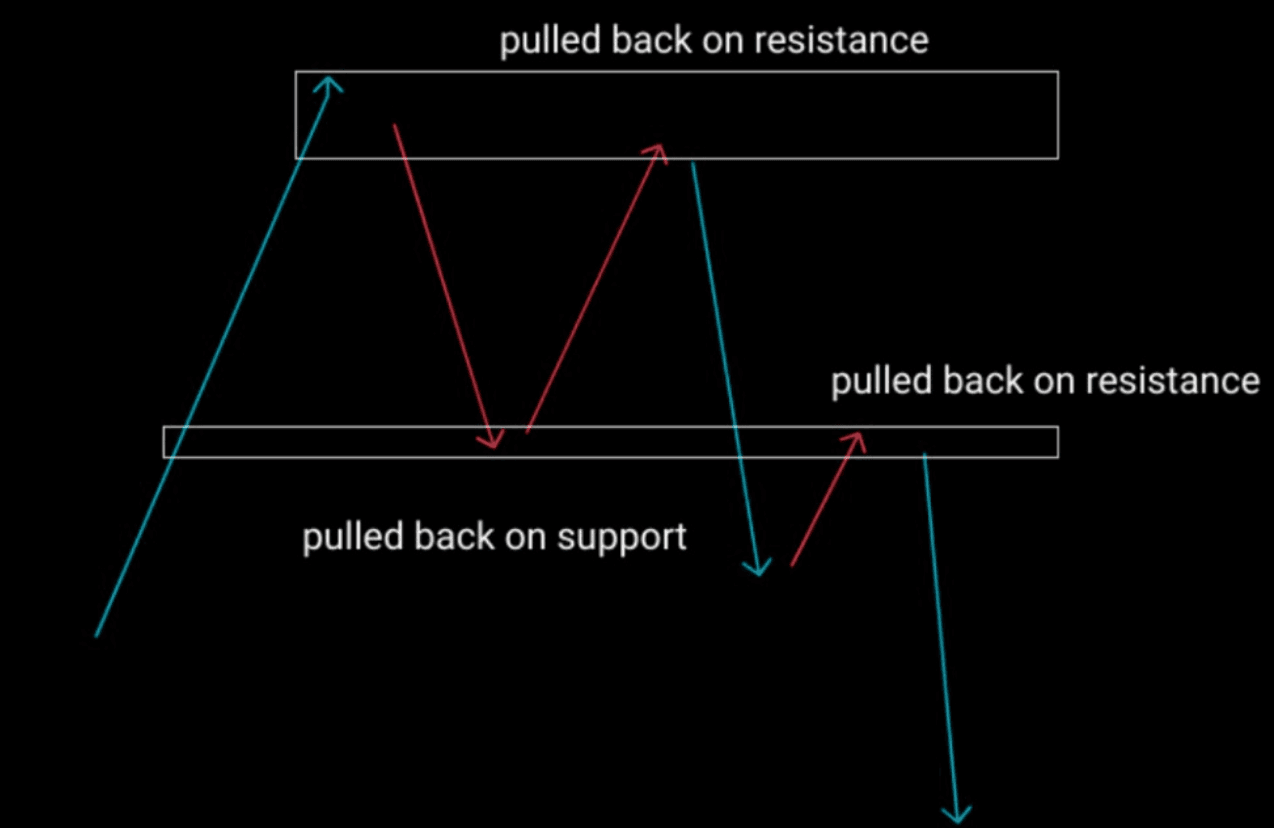
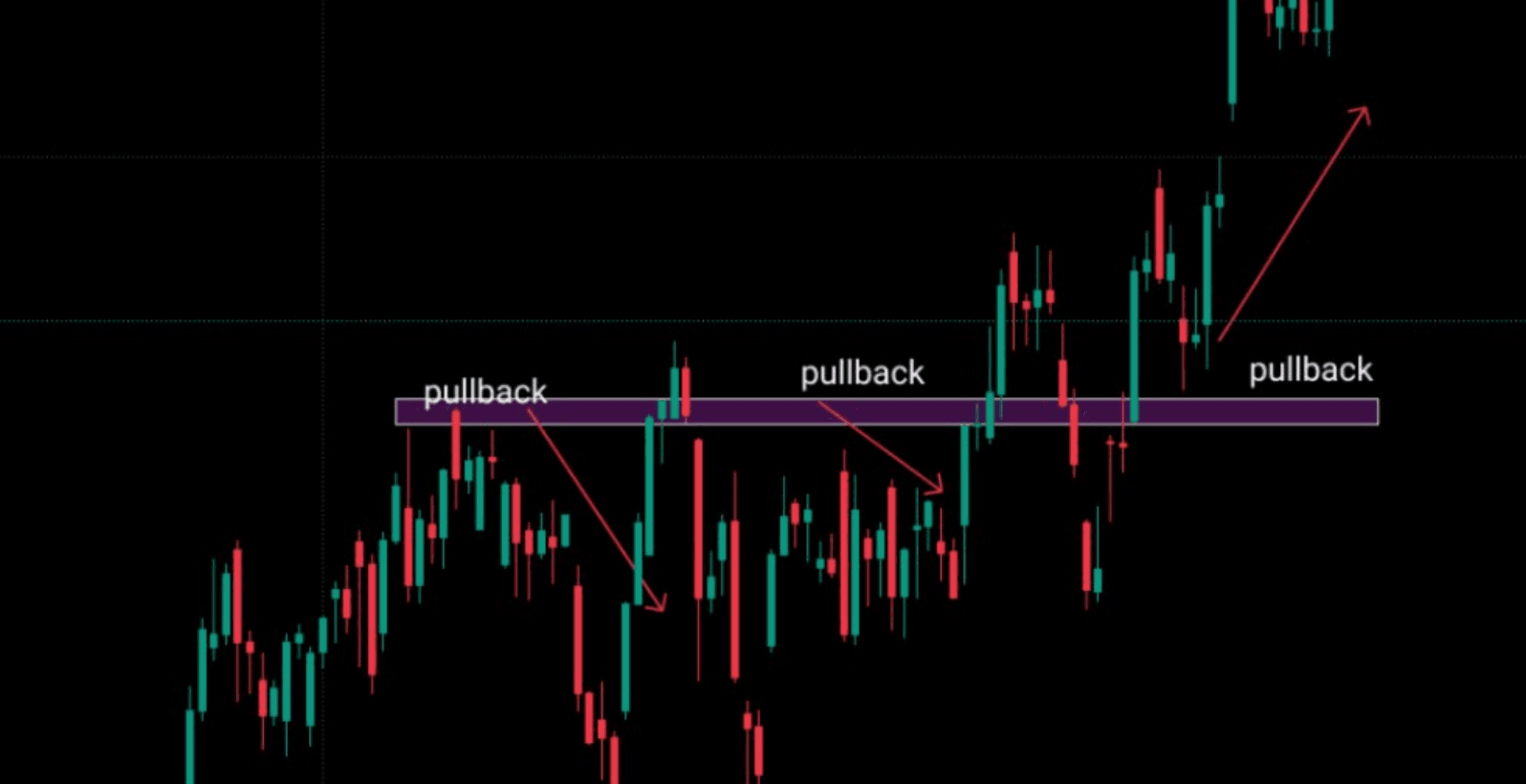
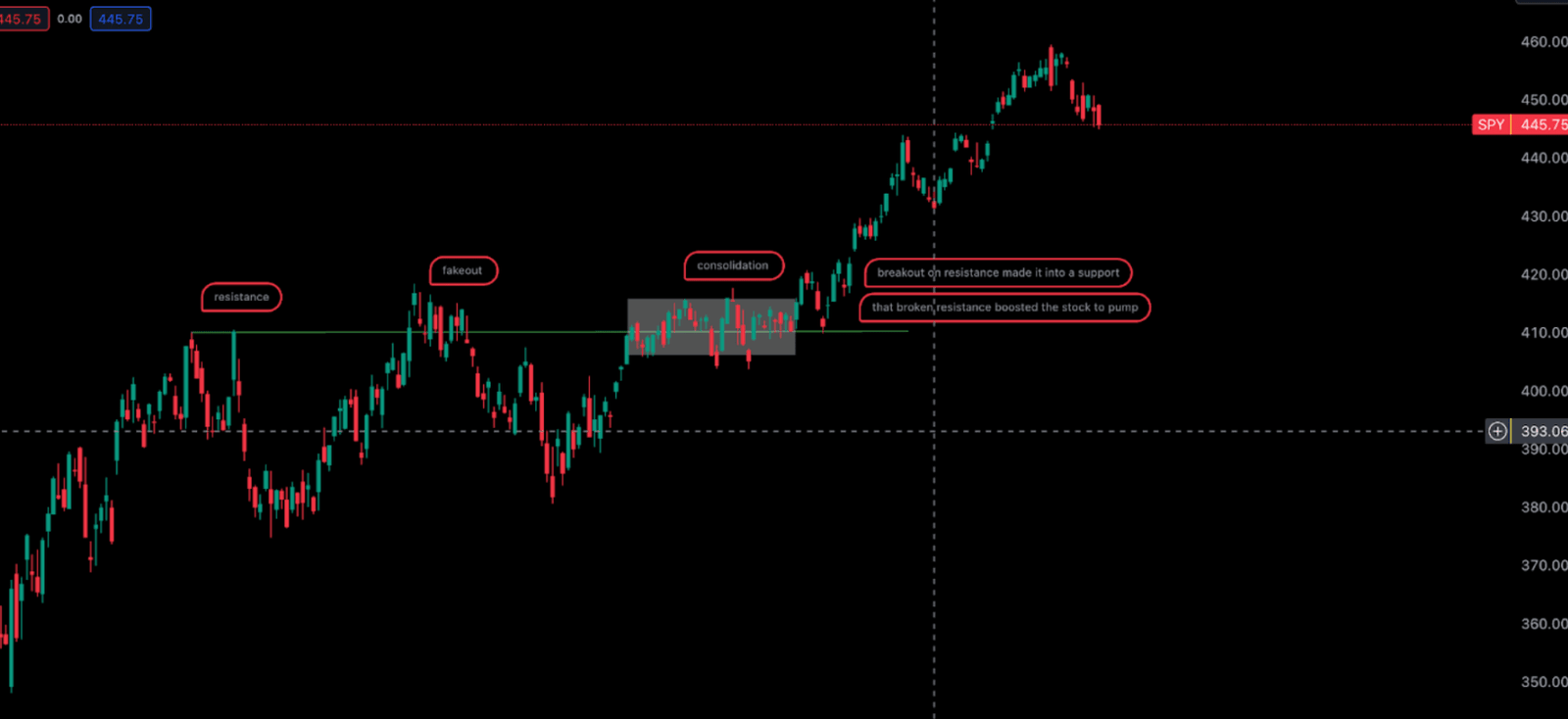
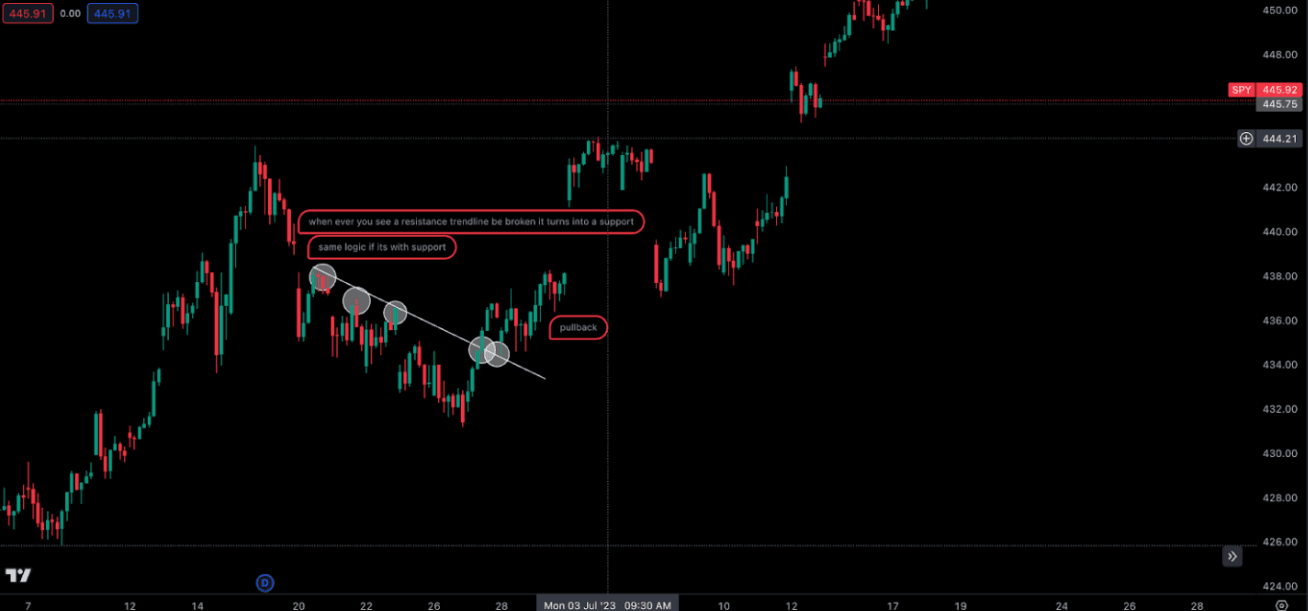
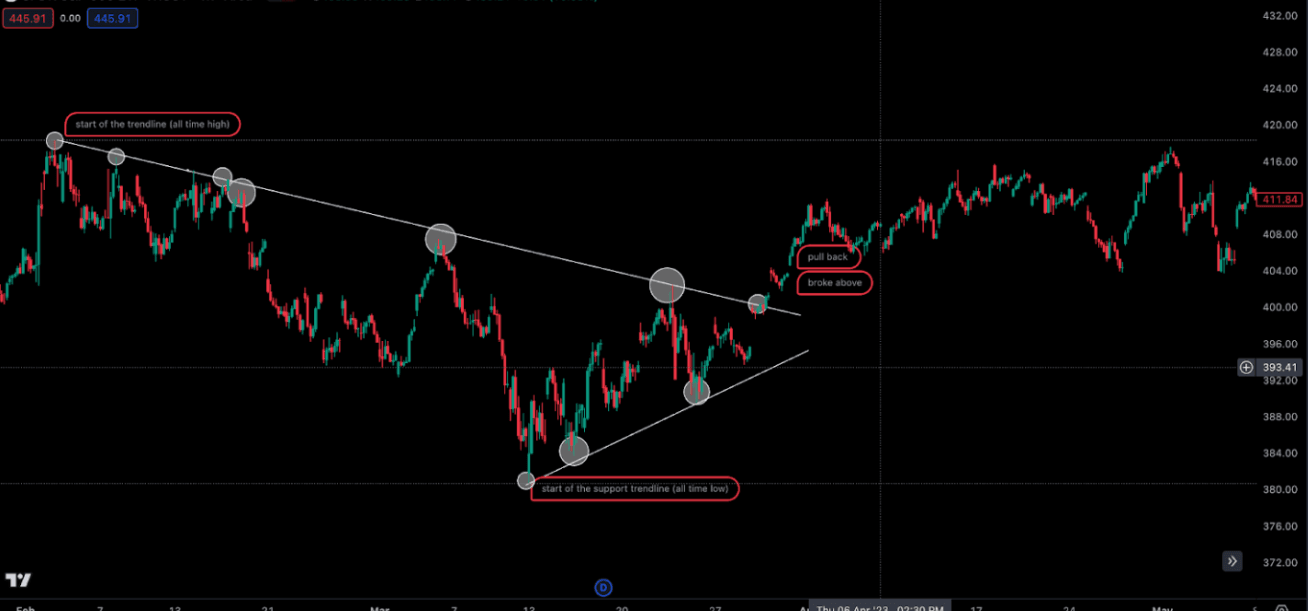
When price breaks a Support/Resistance level or trendline, it will often pull back to retest that broken level before continuing in the breakout direction. Pullbacks are similar to rejected support or resistance.
Always wait for the pullback before entering — entering at breakout leads to fakeouts
Pullbacks confirm the broken level is now acting as new S/R
Spotted on 5–15 minute timeframes most reliably
The larger the timeframe, the stronger and more reliable the signal
Never chase a breakout candle — wait for the retest
3.11 // Trading Fundamentals
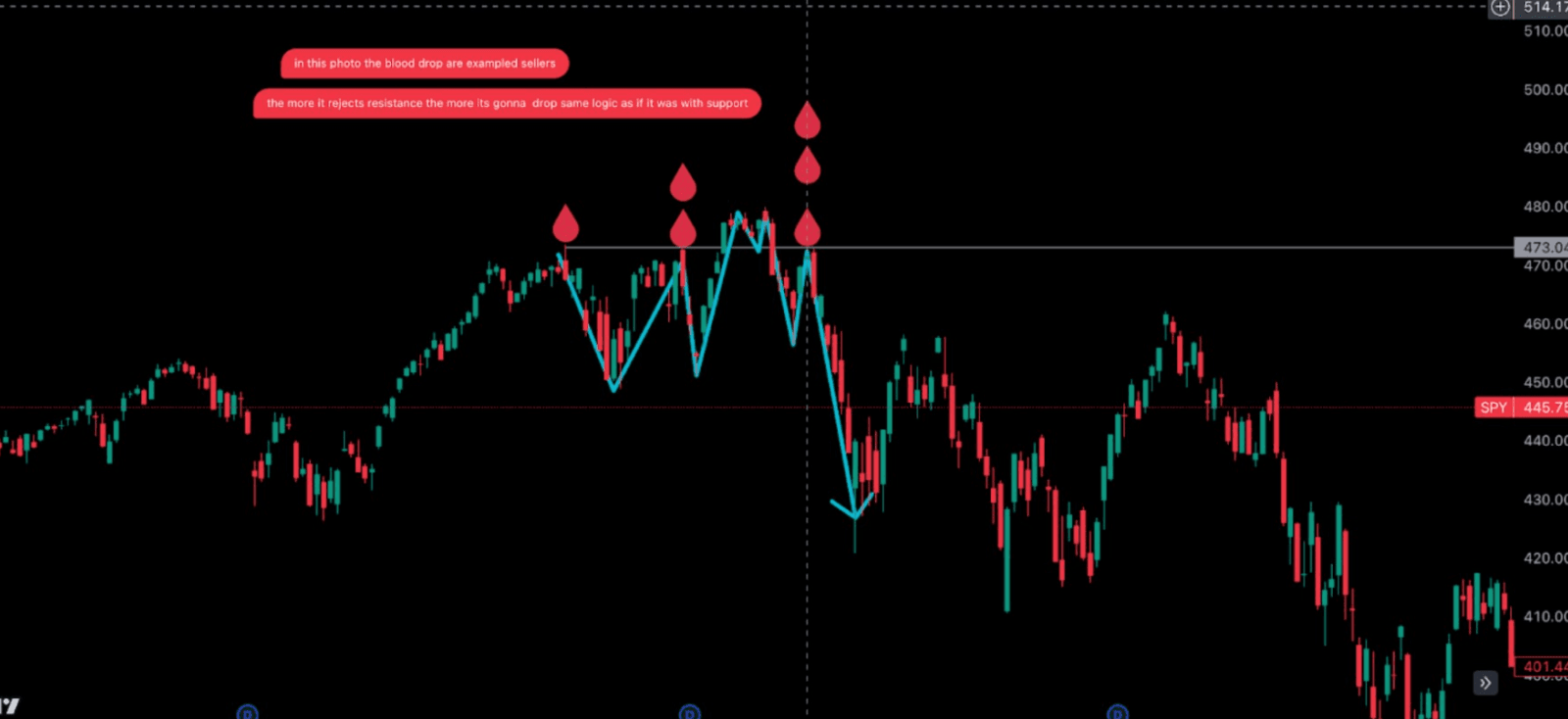
Support & Resistance
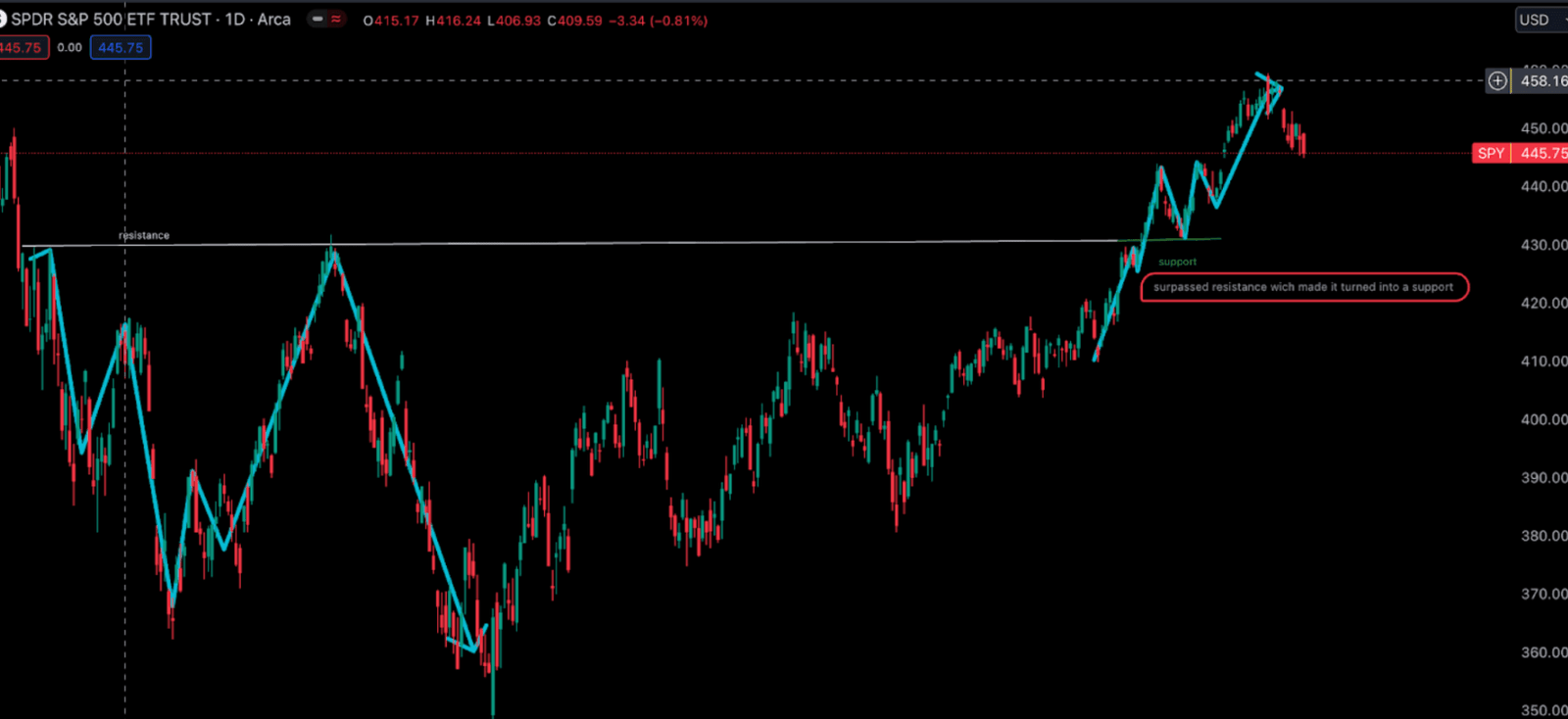
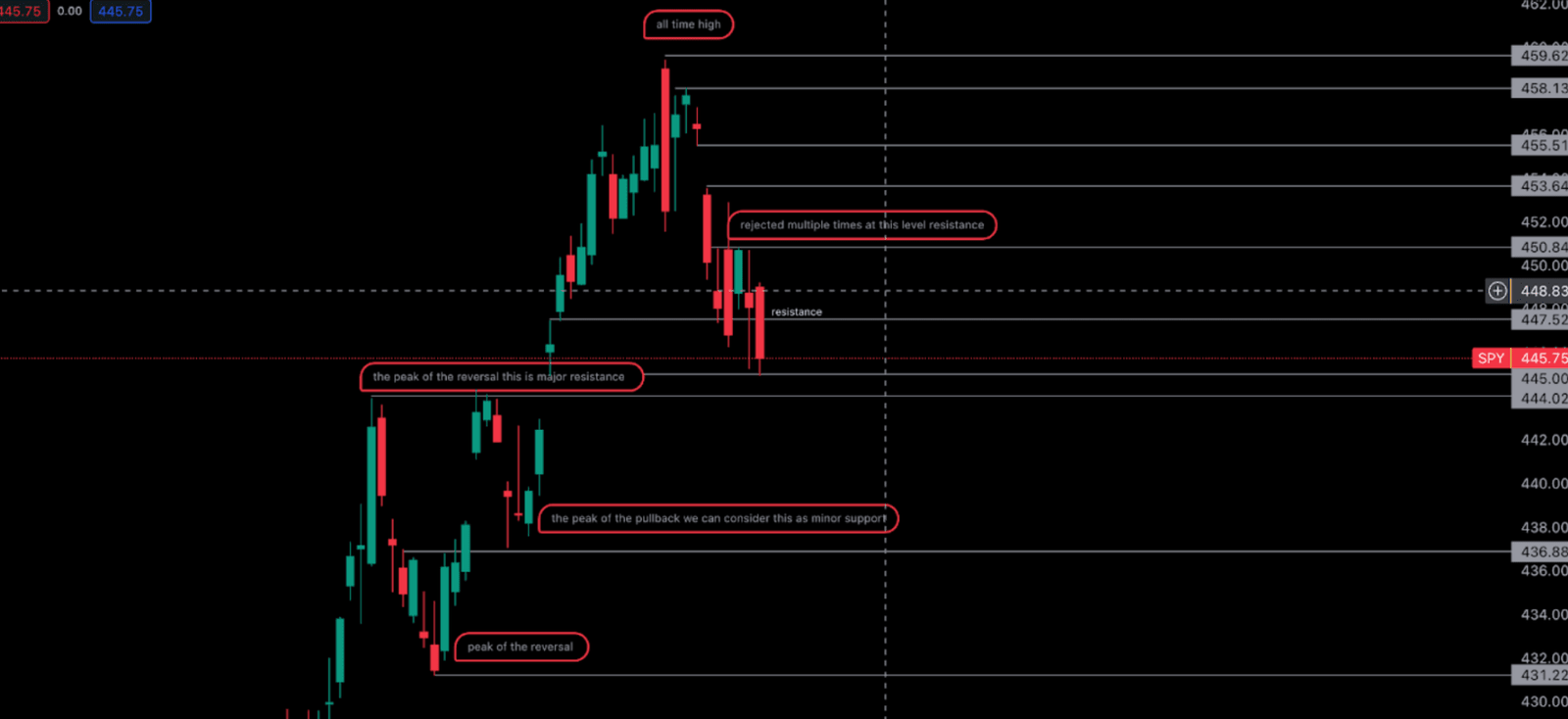
When price breaks a Support/Resistance level or trendline, it will often pull back to retest that broken level before continuing in the breakout direction. Pullbacks are similar to rejected support or resistance.
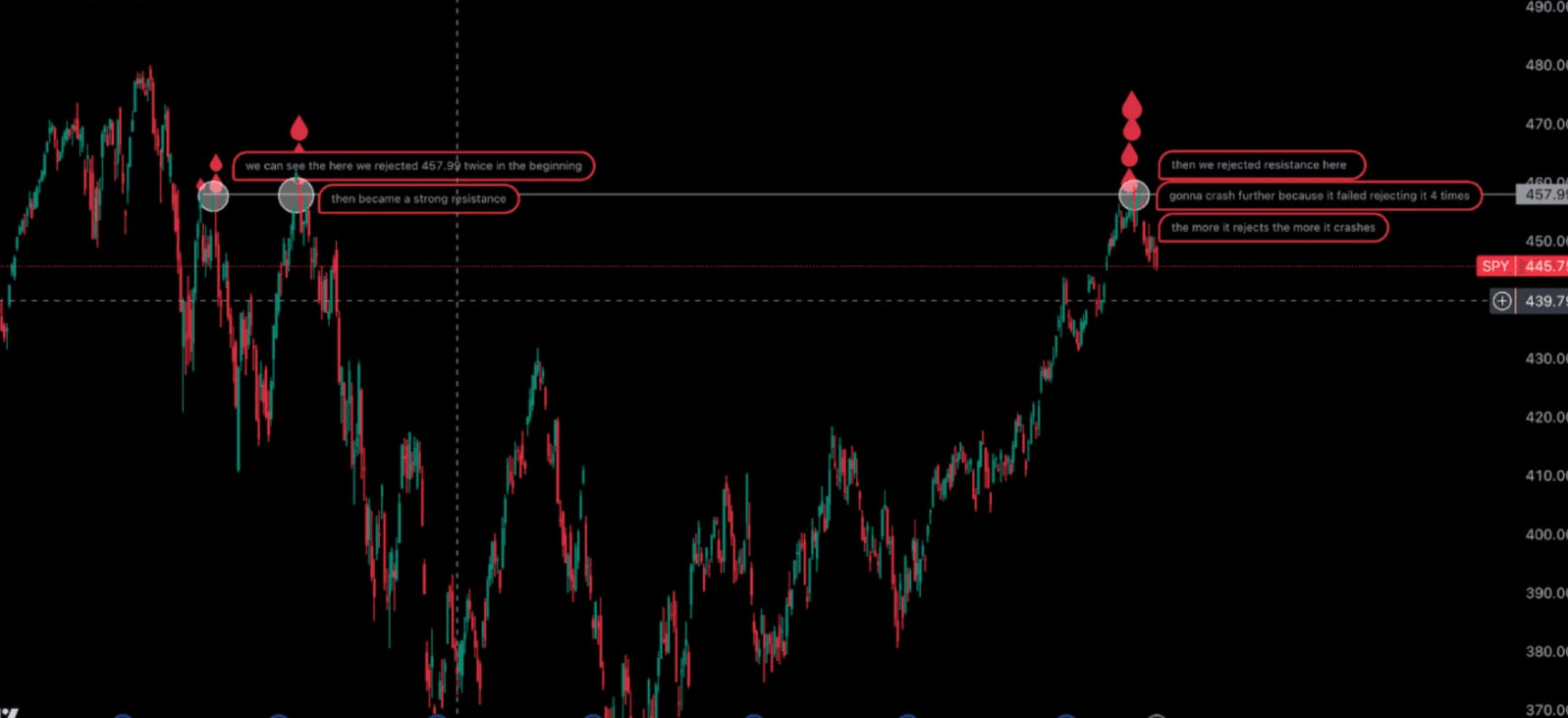
Support is below the current price — where buyers consistently step in
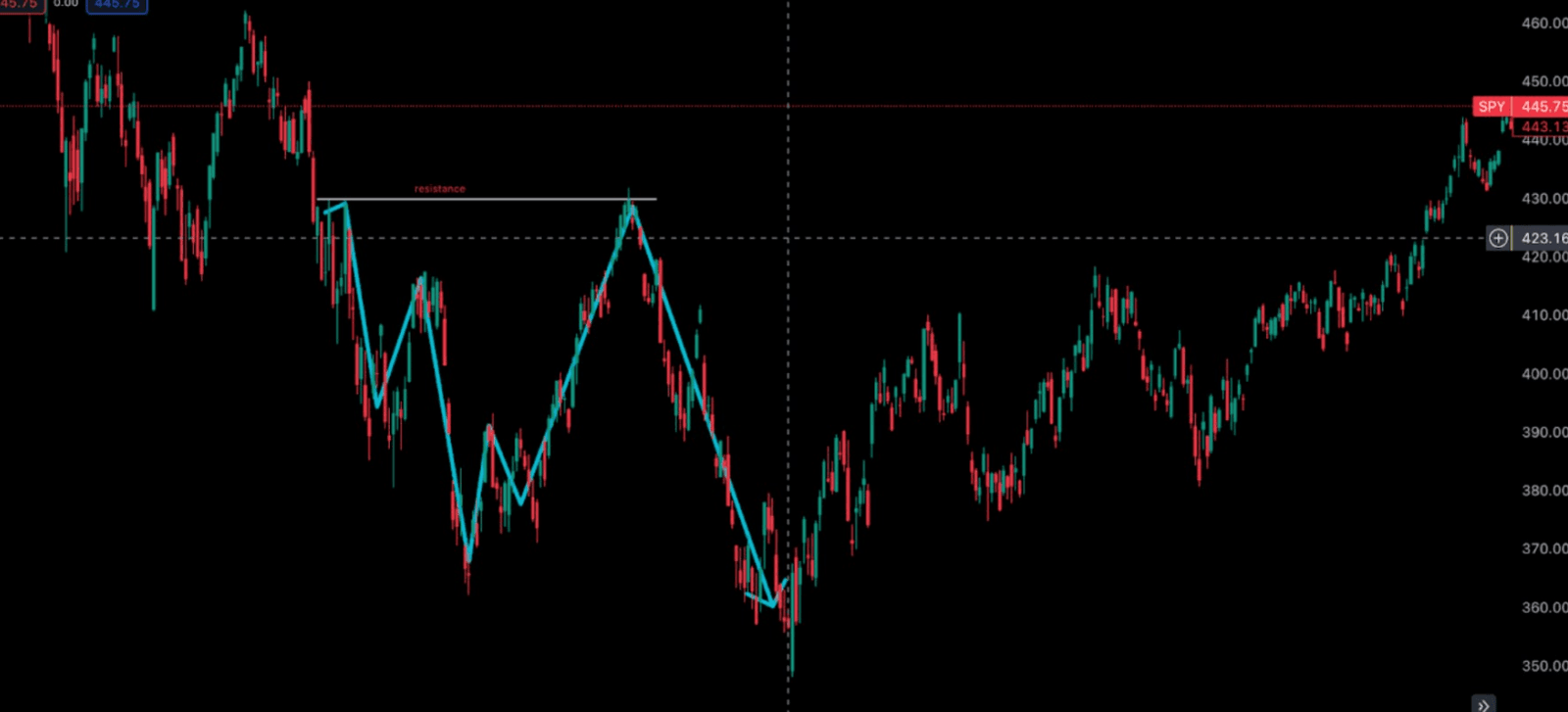
Resistance is above the current price — where sellers dominate
Broken support turns into resistance (now above the price)
Broken resistance turns into support (price broke above it)
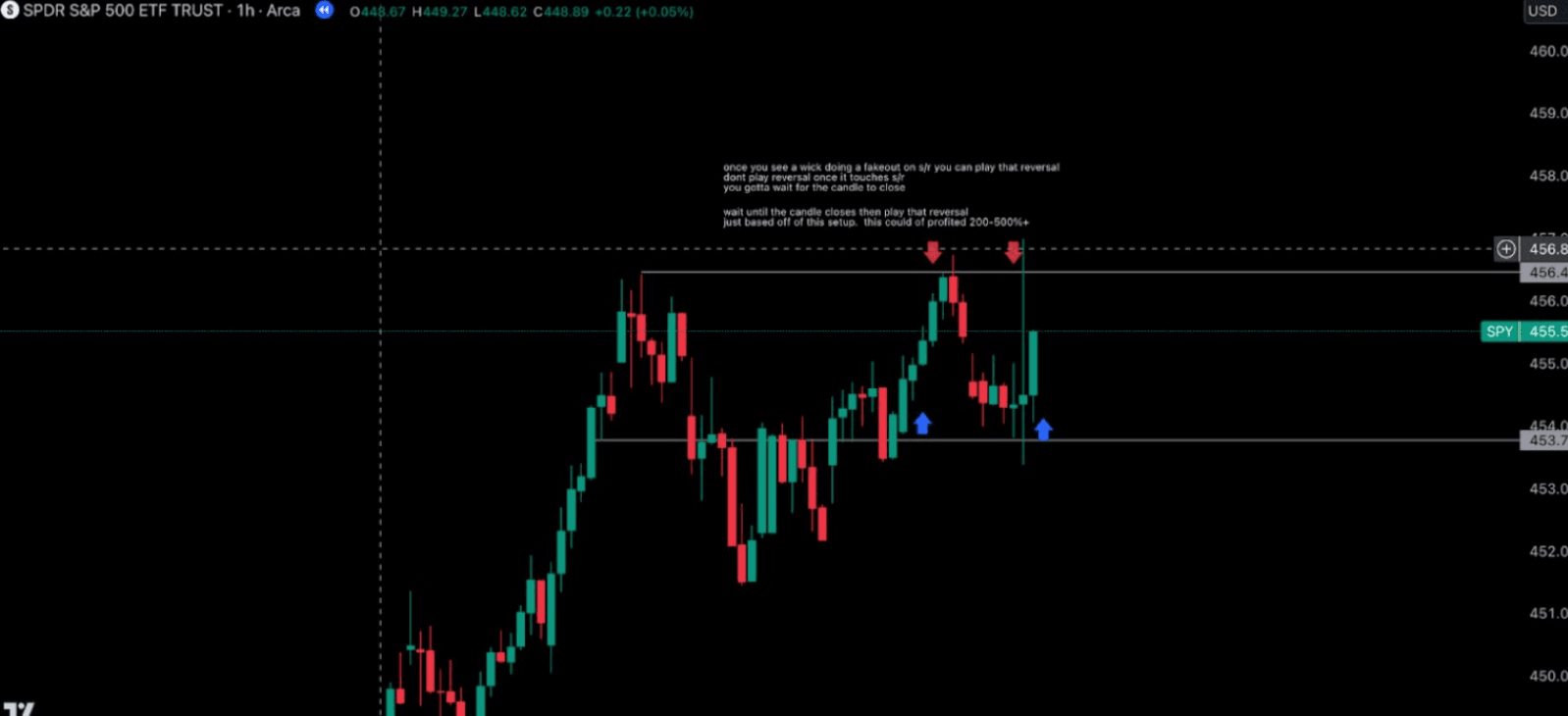
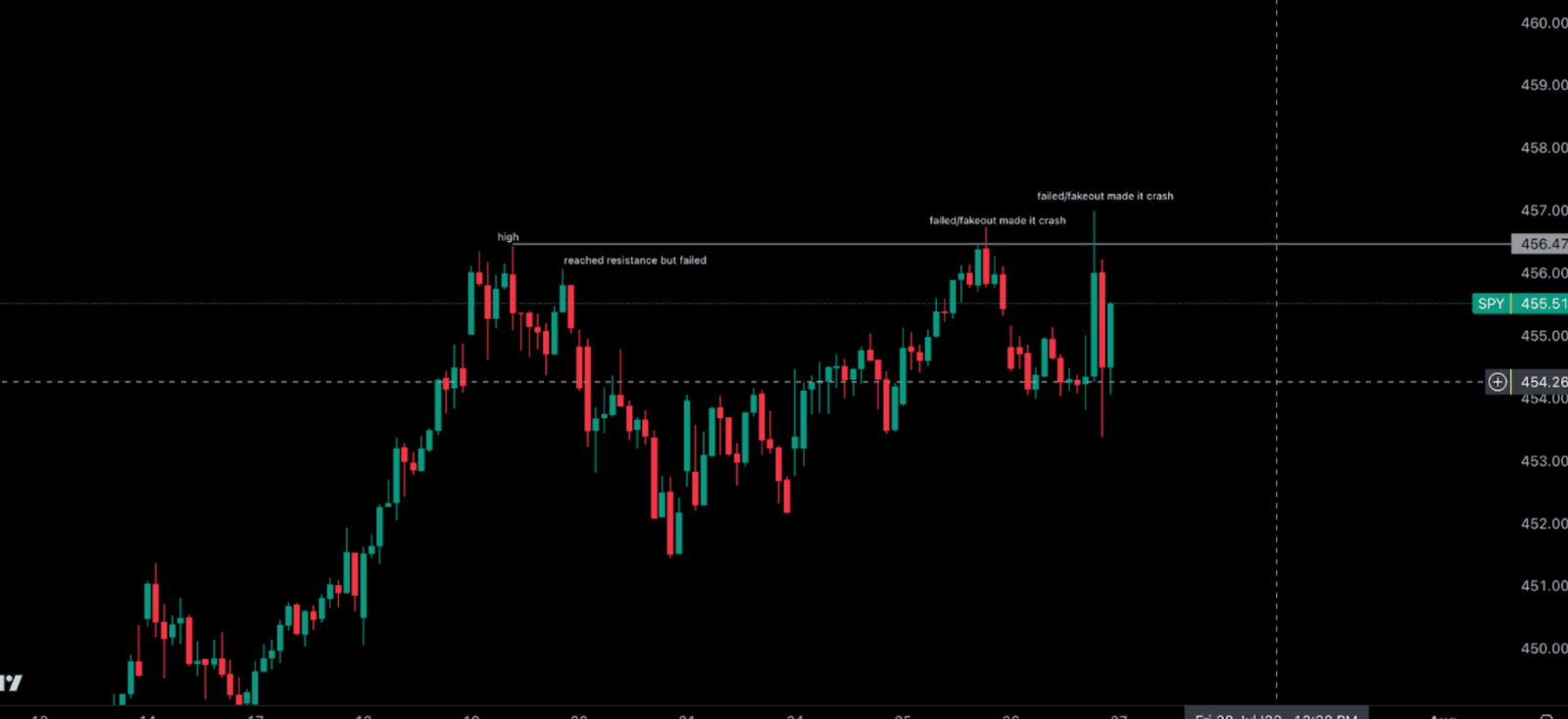
Fakeout on S/R — the subsequent reversal is very strong
Support = bottom of reversals and pullback lows
Resistance = top of pullback highs and all-time highs
The more times price touches an S/R without breaking, the stronger the zone
S/R level typically breaks after 2–3+ touches — rarely on the first
3.12 // Trading Fundamentals
Trendlines
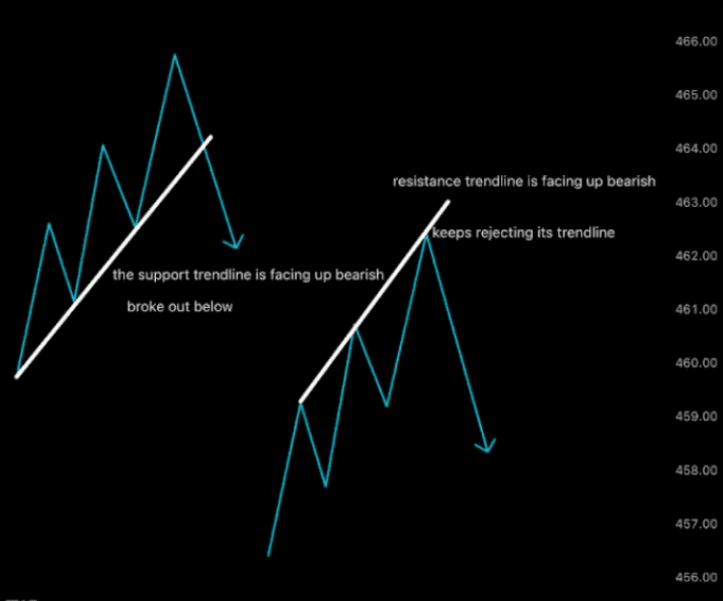
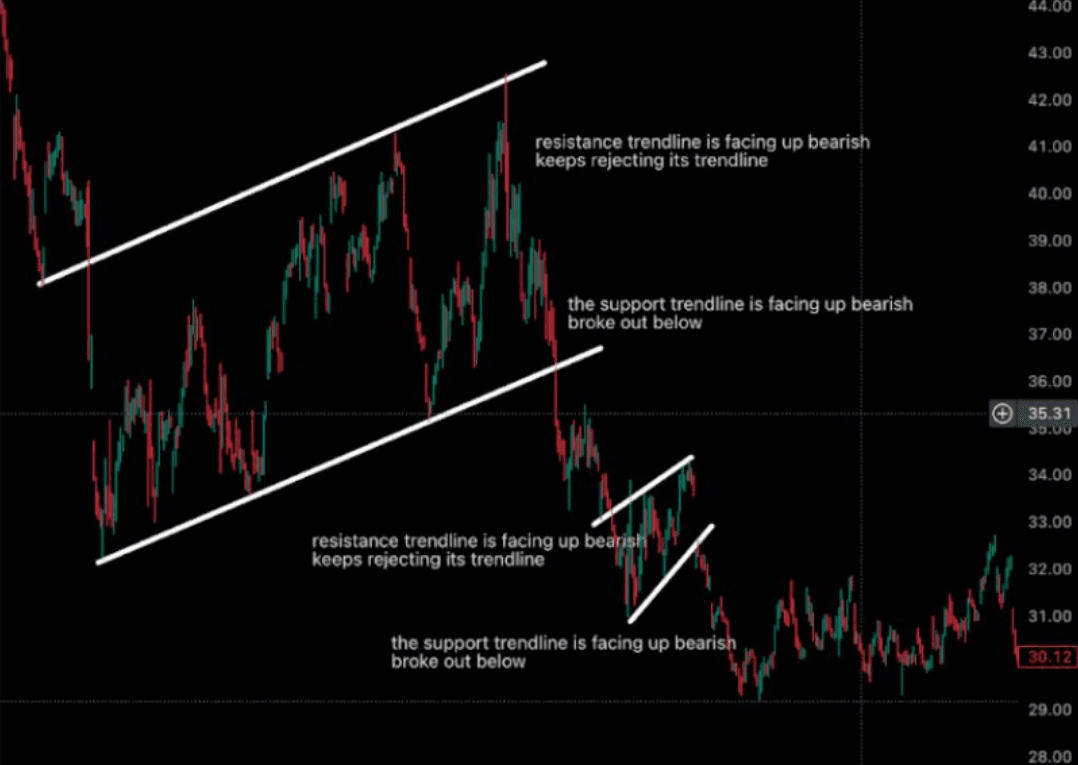
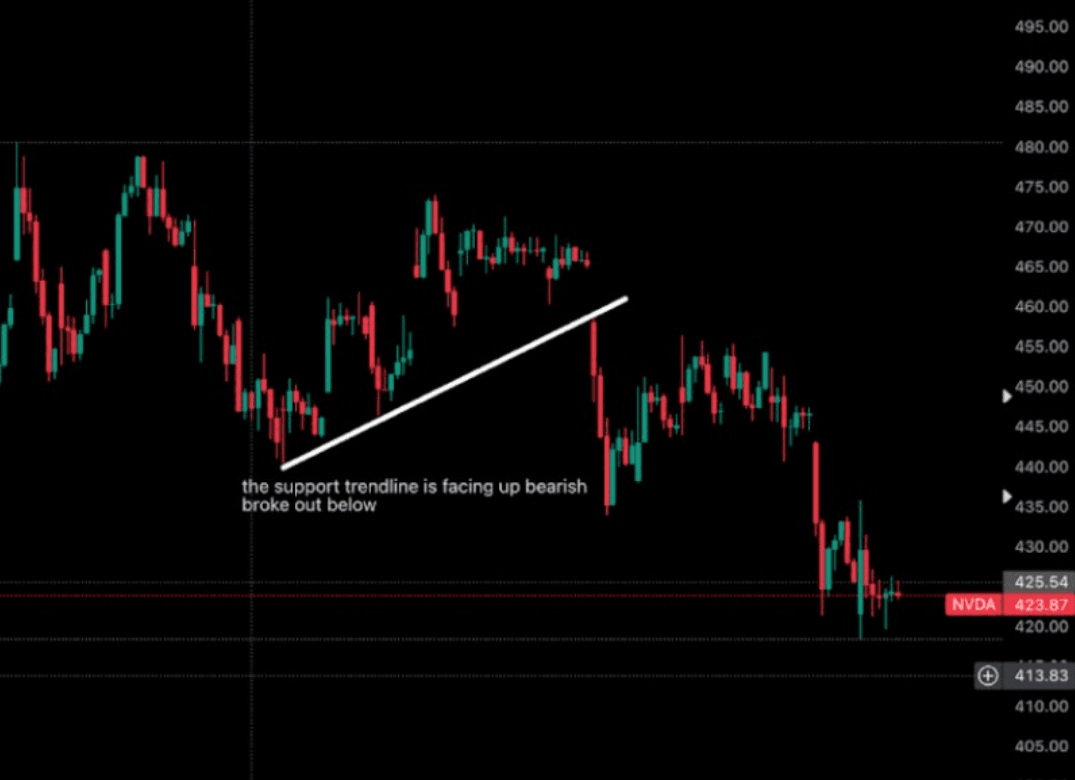
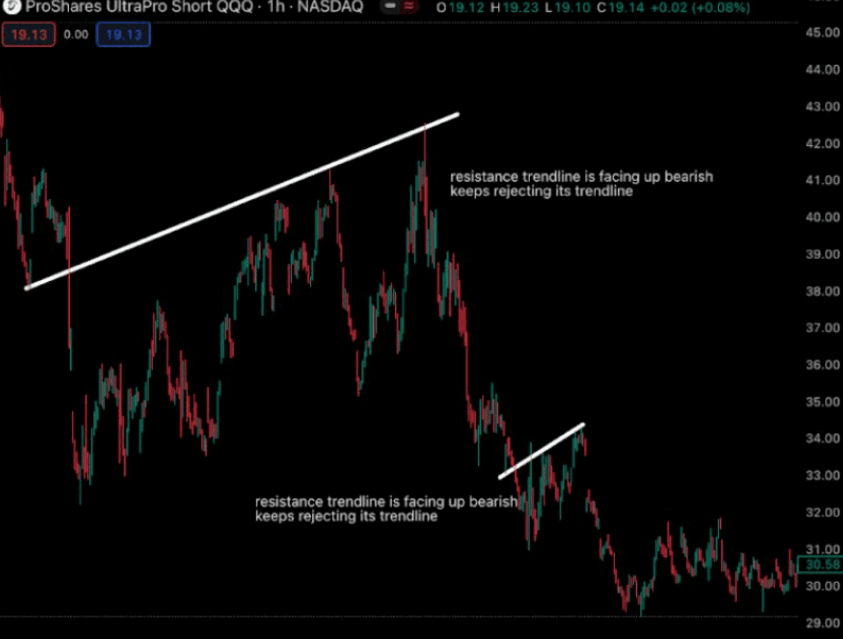
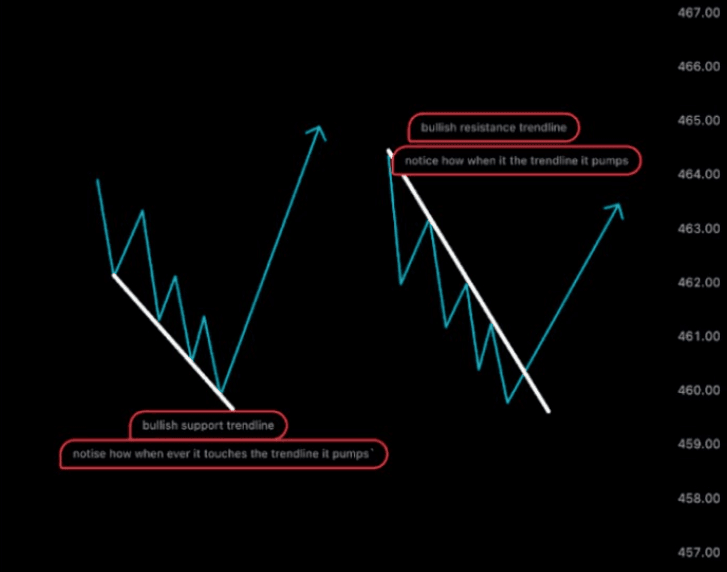
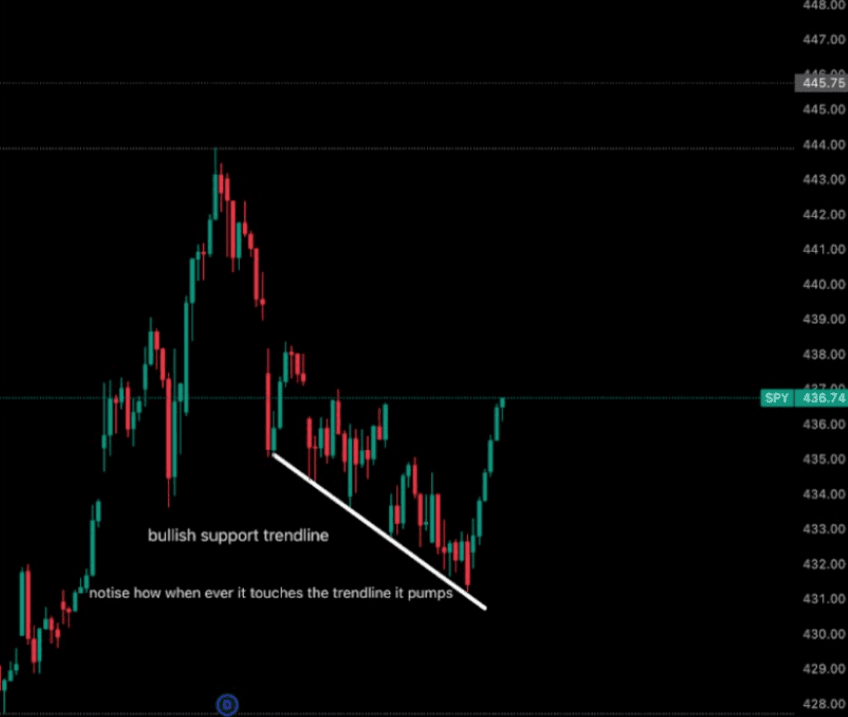
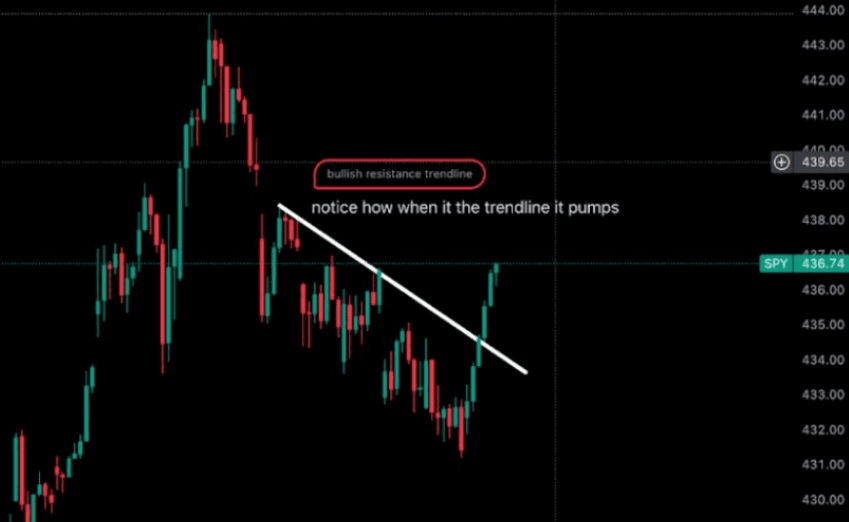
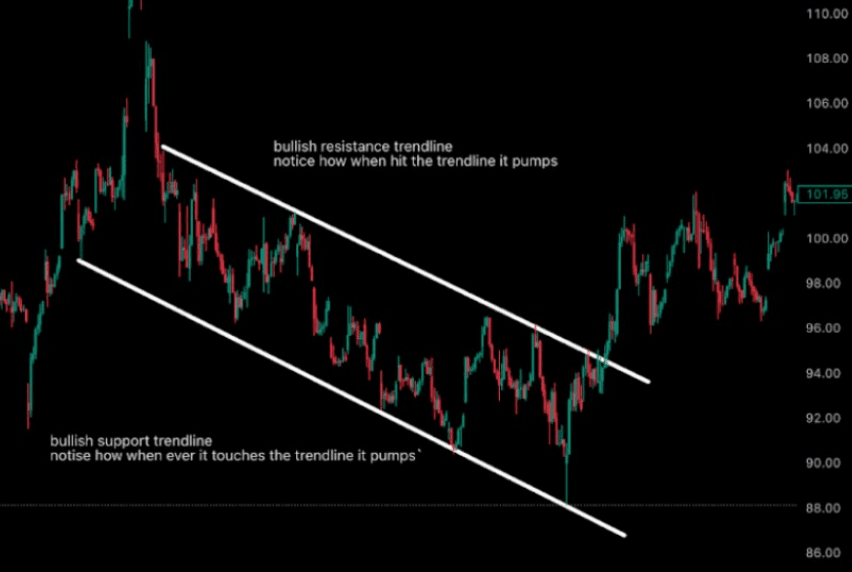
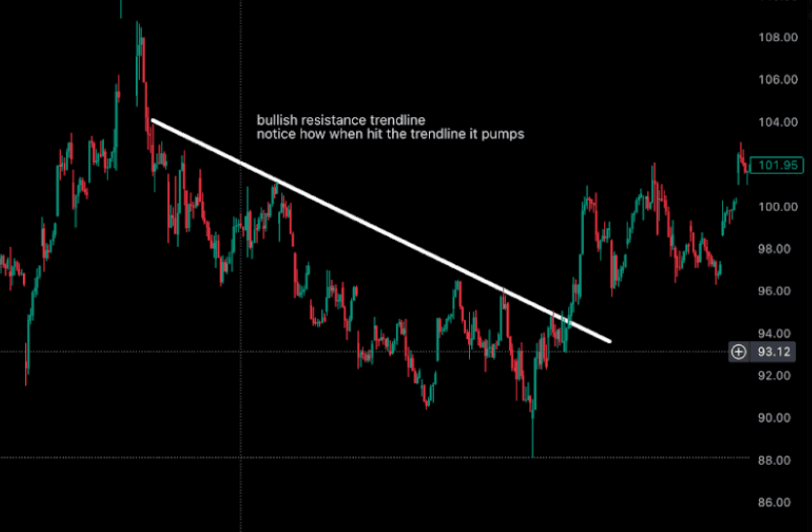
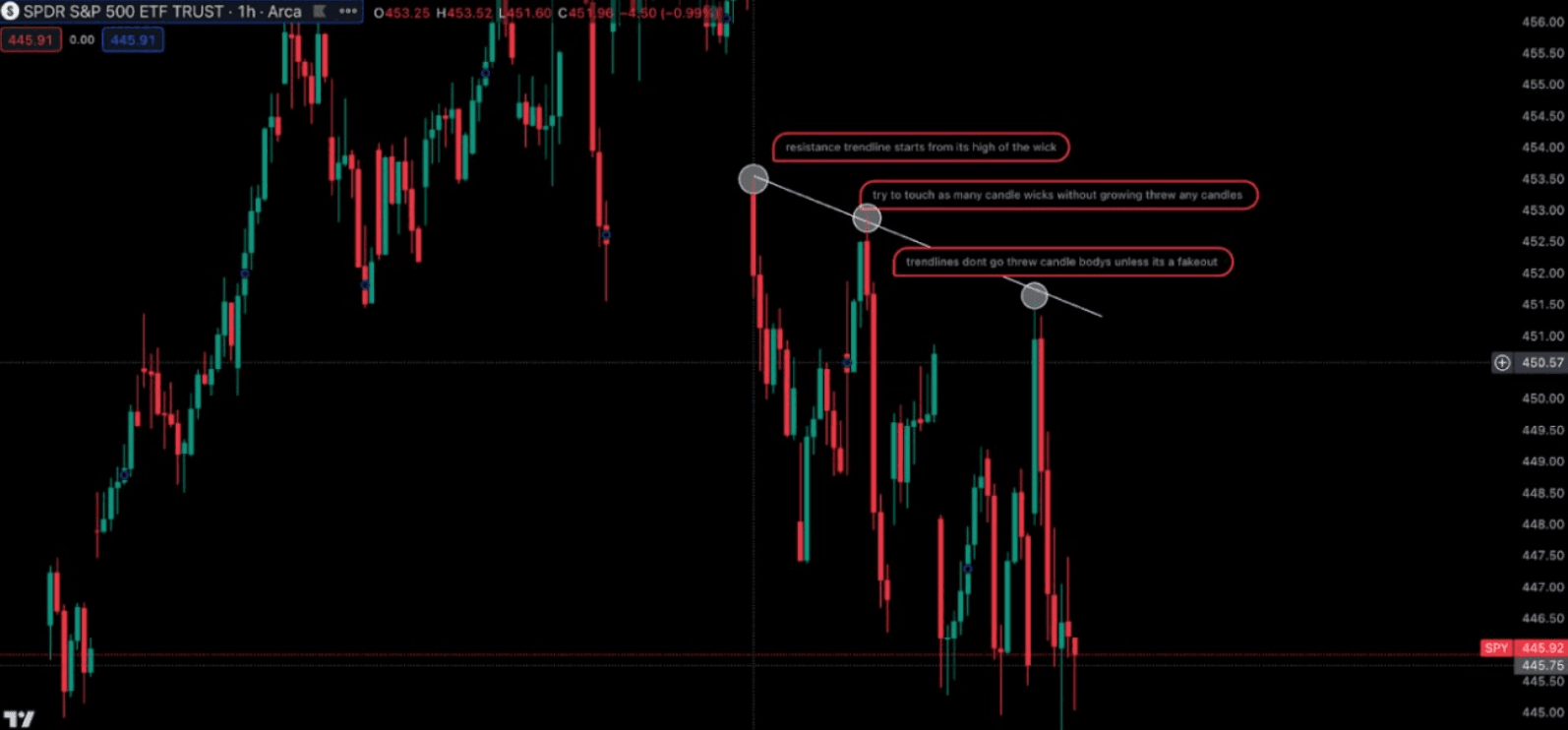
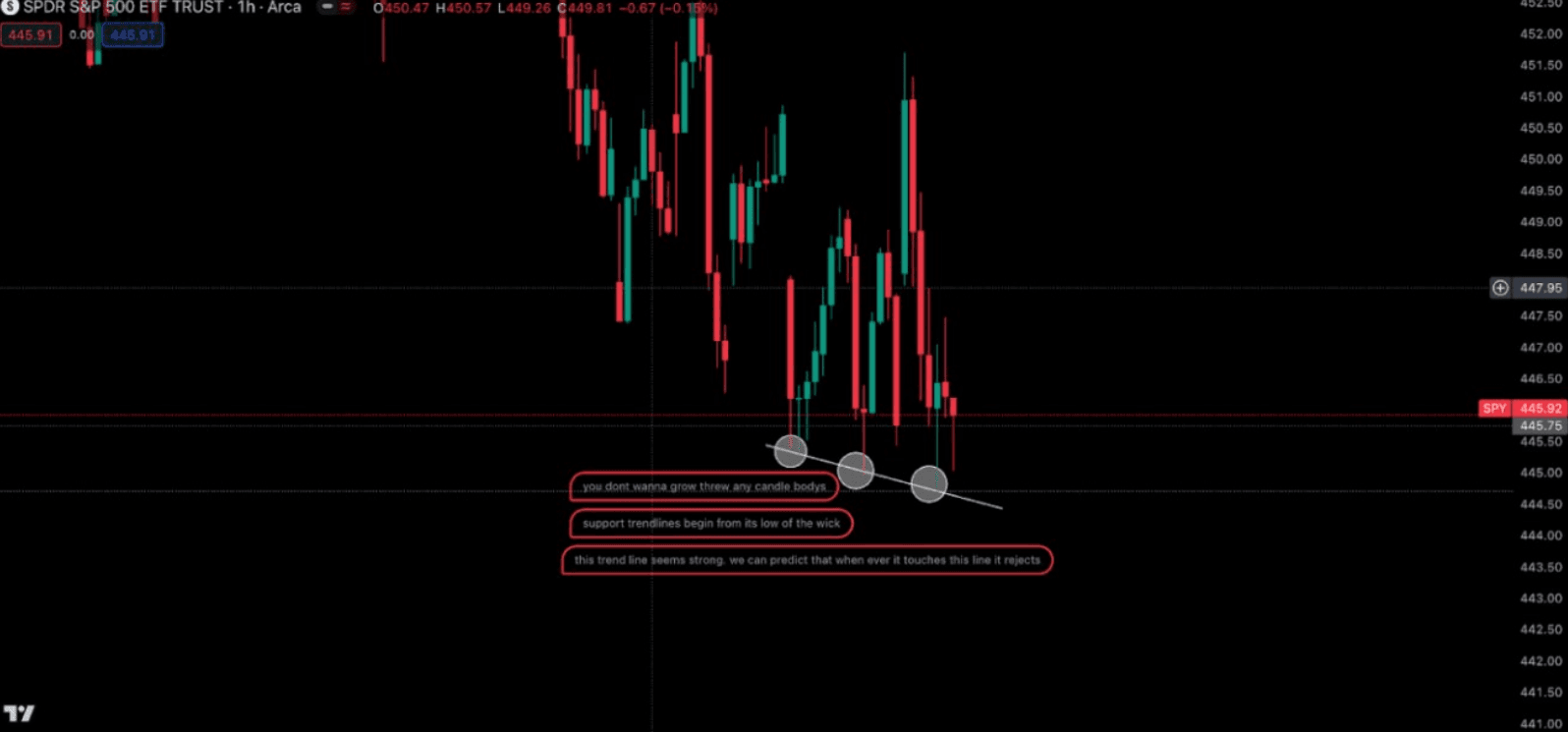
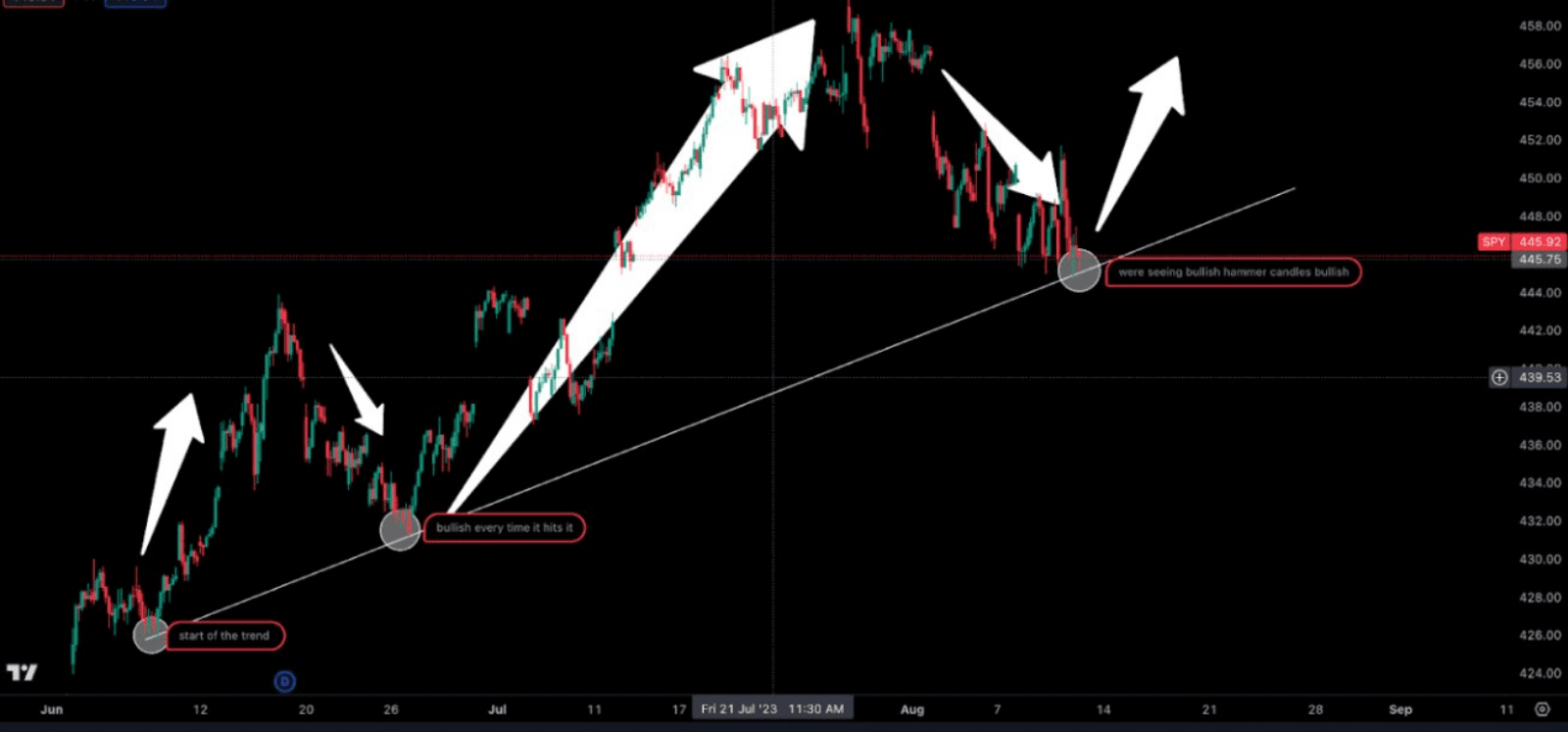
Trendlines are like S/R levels but drawn at an angle across swing highs and lows. There are 4 types: bullish support, bullish resistance, bearish support, and bearish resistance.
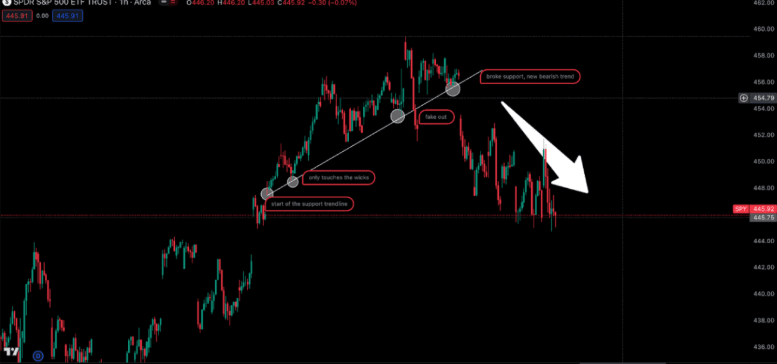
Draw from candle wicks — not through candle bodies (unless a fakeout)
Support trendline: starts from the low of the candle wick
Resistance trendline: starts from the high of the candle wick
Trendlines begin when price reverses or starts a new trend
Do not draw trendlines in choppy / sideways zones
Work best on larger timeframes (1H, 4H, Daily)
Steep trendlines break easily — moderate angles are more reliable
Broken resistance trendline → becomes support trendline (and vice versa)
Bearish Trendlines
Easy to understand and useful in smaller timeframes. You can enter whenever price rejects off the trendline — no need to wait for a pullback. Bullish trendlines are the exact same concept in reverse.
Bullish Trendlines
There are 4 types of trendlines total: 2 support types and 2 resistance types. For bullish: one bullish support and one bullish resistance type.
Drawing Trendlines
Module // 04
Advanced Concepts
4.1 // Trading Fundamentals
Funding Rates & Open Interest
These concepts separate consistently profitable traders from those who are still guessing. Once you’ve mastered Module 3, layer these on top.
What is the Funding Rate?
In perpetual futures there is no expiry date, so the funding rate keeps the futures price anchored to the spot price. It is a periodic payment between long and short traders, typically every 8 hours.
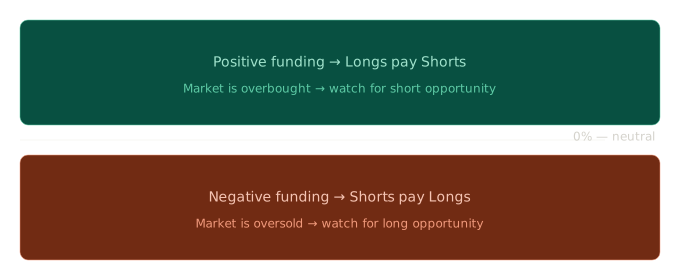
Positive funding: longs pay shorts — market is overbought, watch for short opportunity
Negative funding: shorts pay longs — market is oversold, watch for long opportunity
Extreme positive funding (+0.1% per 8h): longs are overleveraged — strong short signal as a confluence
Check live funding rates on Coinglass (coinglass.com)
Use as confluence, not as a standalone entry signal
What is Open Interest?
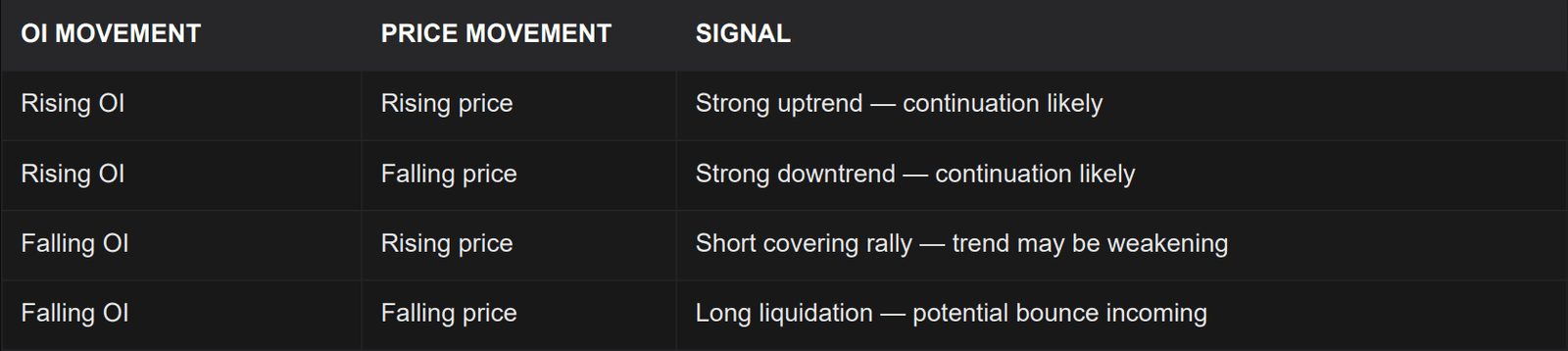
Open Interest = total value of all outstanding futures contracts. It tells you how much capital is actively bet on the market.
4.2 // Trading Fundamentals
Market Sessions & Kill Zones
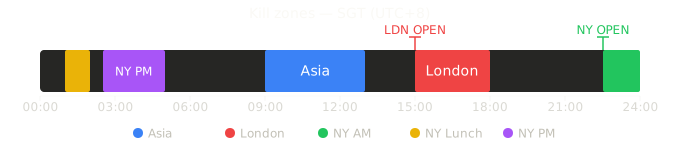
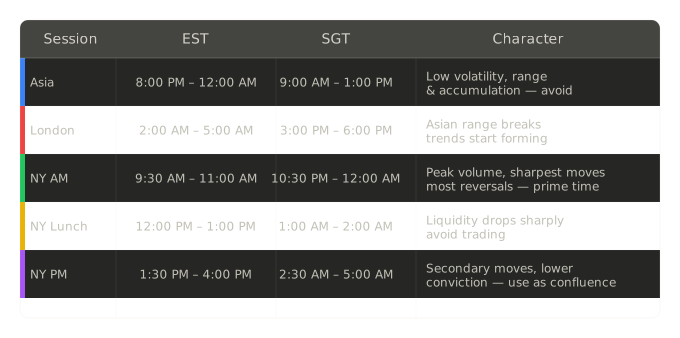
Crypto trades 24/7 but volatility is NOT evenly distributed. Certain market sessions carry far more volume and liquidity — and these are when the best setups form.
1:58 – Session Timing
Best windows: London Open (3pm SGT) and NY Open (9:30pm SGT)
Avoid Asian session for active trading unless entirety of NYAM + NYPM was accumulation = distribution possible during Asia
After a usual expansion in NYAM and NYPM its very common for Asia to rebalance and retrace = often opposite direction of NY
Check economic calendar before trading as news events coincide with session opens
Make sure to use Coinglass + AMD + PO3 to make session trading more effective
4.3 // Trading Fundamentals
Backtesting Your Stratergy
Backtesting means applying your strategy to historical data to measure its performance before risking real capital. It builds conviction in a setup so you recognise it and execute it confidently when you see it live.
How to backtest on TradingView:
Open TradingView → select your pair (e.g. SOLUSDT) → set timeframe
Scroll back 3–6 months in chart history
Mark every time your setup appeared (OB + FVG + MSS)
Record: entry, SL, TP1, TP2 — did price hit TP before SL?
Calculate win rate and avg R:R over minimum 50 setups
Only go live with a strategy showing >50% win rate at 1.5:1 R:R or better
4.4 // Trading Fundamentals
Trade Management
Entering a trade is only half the battle. How you manage it after entry determines whether you maximise profits or give them back.
9:07 – When To Add To Position
Set SL and TP BEFORE confirming the trade — non-negotiable
After TP1 hit: move SL to break-even immediately (trade is now free)
After TP2 hit: move SL into profit — you cannot lose now
Scaling out: close 25–50% at TP1, hold rest for TP2/TP3
Scaling in: only if price retraces into OB/FVG after entry — add to winner
Never add to a losing position — this leads to blown accounts
If structure shifts against you before TP: exit early, do not hope
4.5 // Trading Fundamentals
Common Mistakes to Avoid
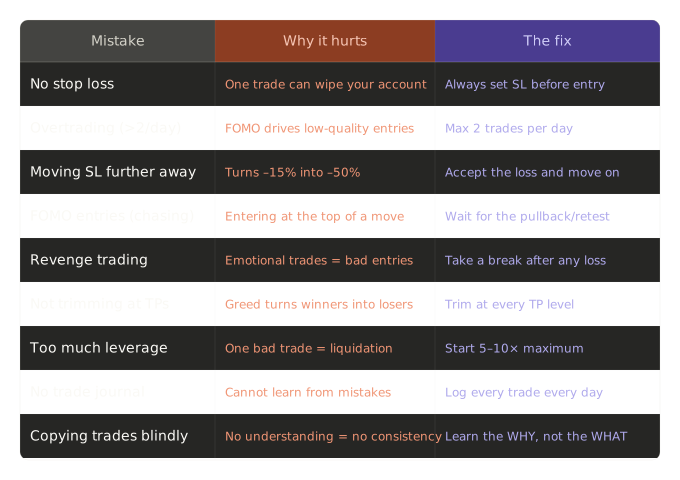
These are the mistakes that cost traders the most money. Theo made every single one of them. Learn from them instead.
Module // 05
Tools for Success
5.1 // Tools for Success
TradingView
TradingView is the industry-standard charting platform. Use it to draw your SMC setups, set price alerts, and monitor all pairs from one dashboard.
Tradingview
Industry standard charting platform
tradingview.com · web, iOS, Android
Free plan is sufficient to start
Draw: OBs, FVGs, trendlines, S/R levels, liquidity zones
Key indicators: EMA (8, 21, 200), VWAP, Volume
Set alerts for key price levels so you never miss a setup
Connect directly to Binance or Bybit for live trading from charts
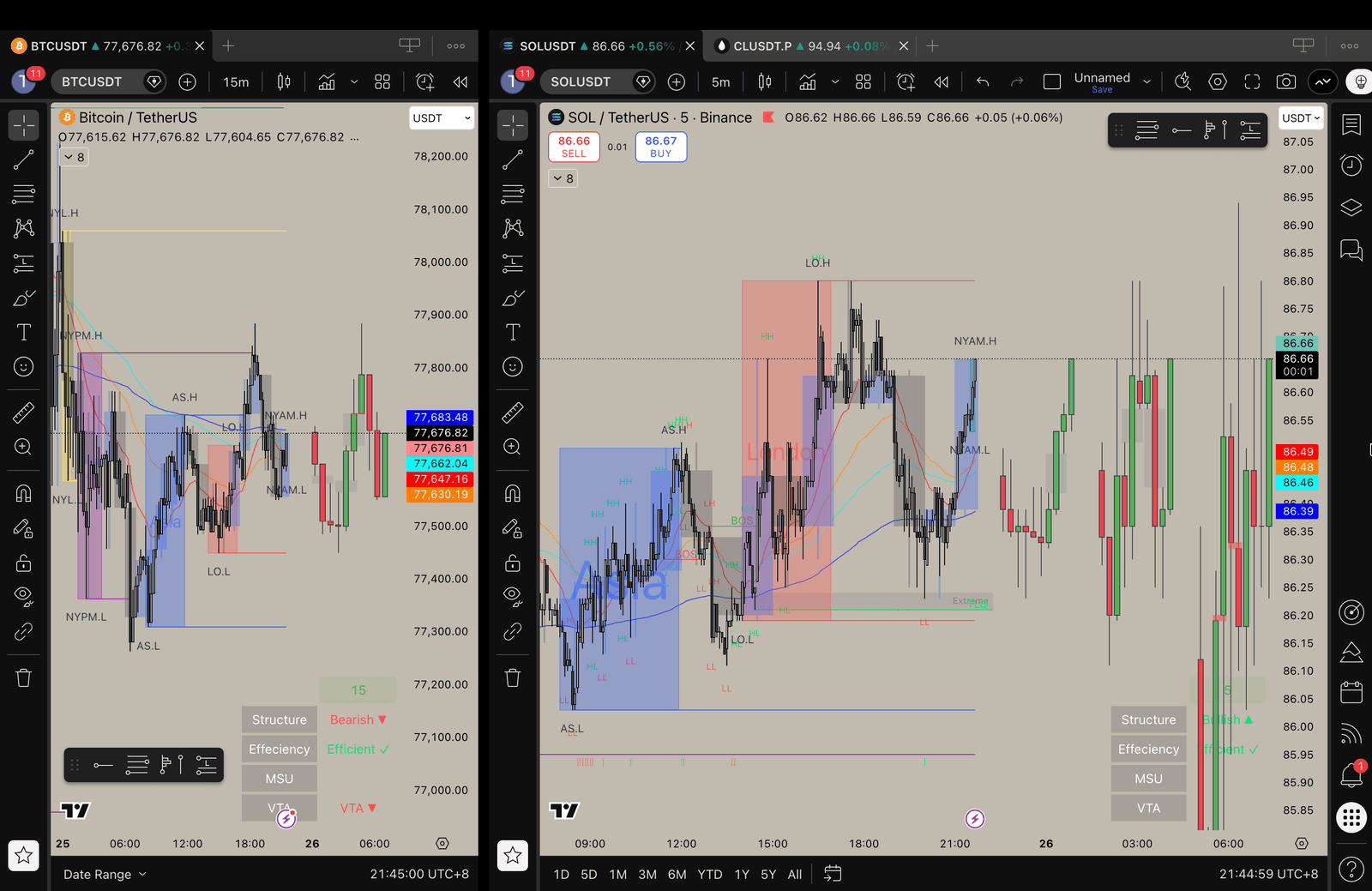
This is what my chart looks like on a typical trading day, sessions marked out, Higher Time Frame (HTF) overlays to avoid having to switch all the time, EMAs and that’s all you really need. Keep it simple.
5.2 // Tools for Success
Coinglass
Coinglass shows live funding rates, liquidation heatmaps, and open interest across all major exchanges. Essential for understanding market positioning and locating large stop-loss clusters.
Coinglass
Visit - coinglass.com
coinglass.com · free to use
Liquidation heatmap: levels with the largest stop-loss clusters
Funding rate tracker: spot extreme positive/negative conditions
Long/Short ratio: understand overall market sentiment
Open Interest: see where the biggest futures bets are placed
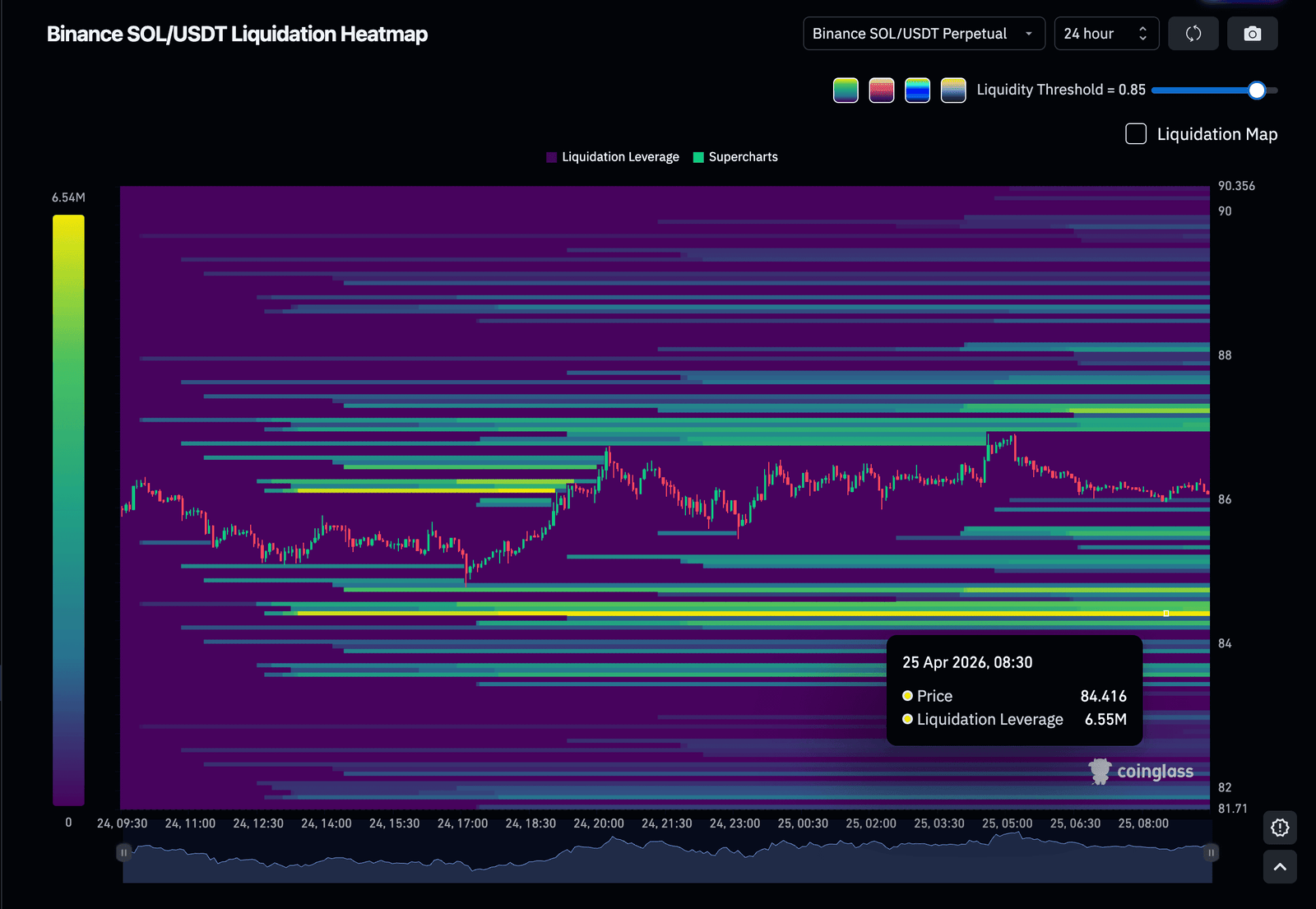
12:00 – Use of Coinglass
5.3 // Tools for Success
Keeping a Trade Journal
A trade journal is the most underrated tool in trading. Without it, you repeat the same mistakes indefinitely.
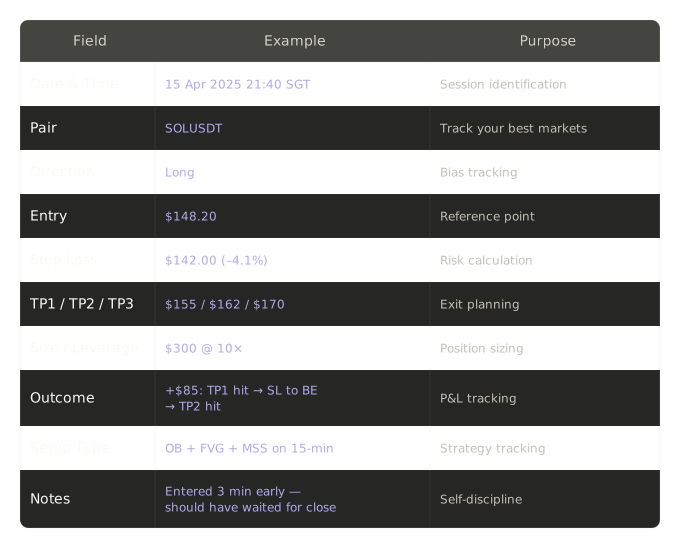
Review weekly — look for patterns in losses
Track win rate and average R:R monthly
If losing: check whether you're deviating from your rules
Use Google Sheets or Notion for easy mobile access
Enter entry price, size, TP, and SL BEFORE confirming
Confirm → monitor in "Positions" tab
At TP1: close 50%, move SL to break-even
At TP2: move SL into profit, let rest run to TP3
5.4 // Tools for Success
Useful Links Cheat Sheet
Bookmark this. These are the core links you will use every trading day


Module // 06
Your Vault Journey
6.1 // Your Vault Journey
Overview
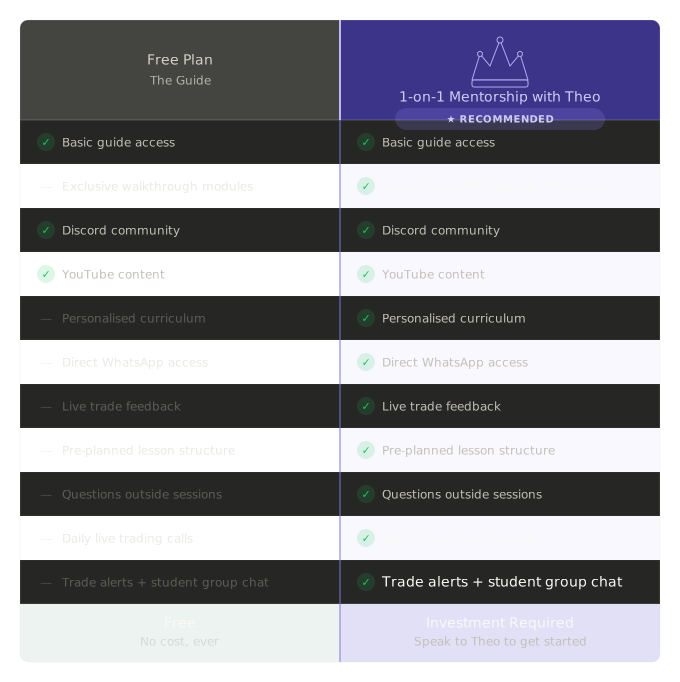
You’ve completed the guide. There are two ways to continue your journey with Vault Collective: